
Join Our JEE Preparation Group
Prep with like-minded aspirants; Get access to free daily tests and study material.
Sign in
Please select an account to continue using cracku.in
↓ →
Join Our JEE Preparation Group
Prep with like-minded aspirants; Get access to free daily tests and study material.
Consider the following data.
| Electrolyte | $$\Lambda^\circ_m$$ (S cm$$^2$$ mol$$^{-1}$$) |
|---|---|
| BaCl$$_2$$ | $$x_1$$ |
| H$$_2$$SO$$_4$$ | $$x_2$$ |
| HCl | $$x_3$$ |
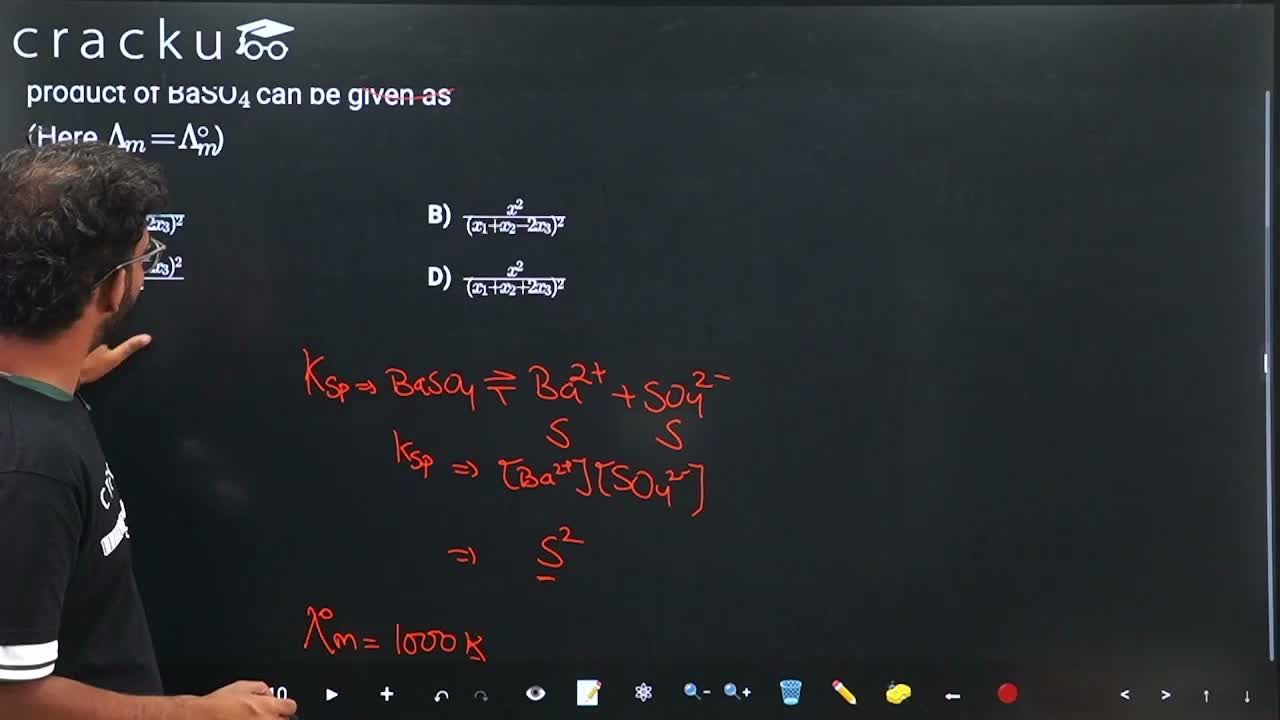
BaSO$$_4$$ is sparingly soluble in water. If the conductivity of the saturated BaSO$$_4$$ solution is $$x$$ S cm$$^{-1}$$ then the solubility product of BaSO$$_4$$ can be given as
(Here $$\Lambda_m = \Lambda^\circ_m$$)
According to Kohlrausch's Law, the limiting molar conductivity of an electrolyte is equal to the sum of the limiting ionic conductivities of its constituent ions.
Given,
$$\Lambda_m^0(BaCl_2)=x_1=\lambda_{Ba^{2+}}^0+2\lambda_{Cl^-}^0,$$
$$\Lambda_m^0(H_2SO_4)=x_2=2\lambda_{H^+}^0+\lambda_{SO_4^{2-}}^0,$$
$$\Lambda_m^0(HCl)=x_3=\lambda_{H^+}^0+\lambda_{Cl^-}^0.$$
Hence,
$$\Lambda_m^0(BaSO_4)=\lambda_{Ba^{2+}}^0+\lambda_{SO_4^{2-}}^0,$$
$$\Lambda_m^0(BaSO_4)=\Lambda_m^0(BaCl_2)+\Lambda_m^0(H_2SO_4)-2\Lambda_m^0(HCl),$$
$$\Lambda_m^0(BaSO_4)=x_1+x_2-2x_3.$$
For a sparingly soluble salt,
$$\Lambda_m^0=\frac{1000,\kappa}{S},$$
where $$\kappa=x\ \text{S cm}^{-1}$$ and (S) is the solubility in $$\text{mol L}^{-1}$$.
Therefore,
$$S=\frac{1000x}{\Lambda_m^0(BaSO_4)},$$
$$S=\frac{1000x}{x_1+x_2-2x_3}.$$
Since
$$BaSO_4(s)\rightleftharpoons Ba^{2+}(aq)+SO_4^{2-}(aq),$$
the solubility product is
$$K_{sp}=[Ba^{2+}][SO_4^{2-}]=S^2.$$
Substituting the value of (S),
$$K_{sp}=\left(\frac{1000x}{x_1+x_2-2x_3}\right)^2,$$
$$K_{sp}=\frac{10^6x^2}{(x_1+x_2-2x_3)^2}.$$
Hence, the correct expression for the solubility product is
$$K_{sp}=\frac{10^6x^2}{(x_1+x_2-2x_3)^2}.$$
Was this solution helpful?
Click on the Email ☝️ to Watch the Video Solution
Create a FREE account and get:
_1.webp)

Educational materials for JEE preparation

Ask our AI anything

AI can make mistakes. Please verify important information.
AI can make mistakes. Please verify important information.


