
Join Our JEE Preparation Group
Prep with like-minded aspirants; Get access to free daily tests and study material.
Sign in
Please select an account to continue using cracku.in
↓ →
Join Our JEE Preparation Group
Prep with like-minded aspirants; Get access to free daily tests and study material.
One mole each of He and A(g) are taken in a 10 L closed flask and heated to 400 K to establish the following equilibrium.
A(g) $$\rightleftharpoons$$ B(g)
K$$_c$$ for this reaction at 400 K is 4.0. The partial pressures (in atm) of He and B(g) are respectively (at equilibrium)
(Assume He, A(g) and B(g) behave as ideal gases)
(Given: R = 0.082 L atm K$$^{-1}$$ mol$$^{-1}$$)
For the equilibrium
$$A(g)\rightleftharpoons B(g),$$
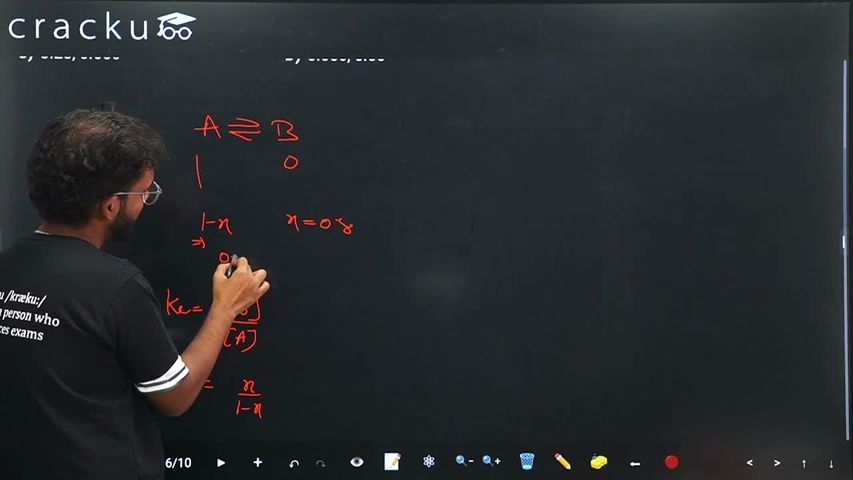
let (x) moles of (A) be converted into (B).
At equilibrium,
$$n_A=1-x,\qquad n_B=x,\qquad n_{He}=1.$$
Using the expression for the equilibrium constant,
$$K_c=\frac{[B]}{[A]}=\frac{x/V}{(1-x)/V}=\frac{x}{1-x}=4.$$
Solving,
$$x=4(1-x),$$
$$x=4-4x,$$
$$5x=4,$$
$$x=0.8.$$
Therefore, the equilibrium amounts are
$$n_A=0.2\ \text{mol},\qquad n_B=0.8\ \text{mol},\qquad n_{He}=1.0\ \text{mol}.$$
Using the ideal gas equation,
$$P=\frac{nRT}{V},$$
with
$$R=0.082\ \text{L atm K}^{-1}\text{mol}^{-1},\qquad T=400\ \text{K},\qquad V=10\ \text{L},$$
we obtain
$$\frac{RT}{V}=\frac{0.082\times400}{10}=3.28\ \text{atm mol}^{-1}.$$
Hence, the partial pressure of helium is
$$P_{He}=1.0\times3.28=3.28\ \text{atm}.$$
The partial pressure of (B(g)) is
$$P_B=0.8\times3.28=2.624\ \text{atm}.$$
Therefore, the equilibrium partial pressures are
$$P_{He}=3.28\ \text{atm},\qquad P_B=2.624\ \text{atm},$$
which corresponds to Option A.
Was this solution helpful?
Click on the Email ☝️ to Watch the Video Solution
Create a FREE account and get:
_1.webp)

Educational materials for JEE preparation

Ask our AI anything

AI can make mistakes. Please verify important information.
AI can make mistakes. Please verify important information.


