
Join Our JEE Preparation Group
Prep with like-minded aspirants; Get access to free daily tests and study material.
Sign in
Please select an account to continue using cracku.in
↓ →
Join Our JEE Preparation Group
Prep with like-minded aspirants; Get access to free daily tests and study material.
Let $$x = 4$$ be a directrix to an ellipse whose centre is at the origin and its eccentricity is $$\frac{1}{2}$$. If $$P(1, \beta), \beta \gt 0$$ is a point on this ellipse, then the equation of the normal to it at P is:
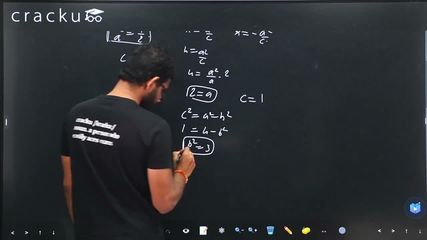
We are told that the line $$x = 4$$ is a directrix of an ellipse whose centre is the origin and whose eccentricity is $$\dfrac12$$. For an ellipse centred at the origin with its major axis along the $$x$$-axis, the standard form is $$\frac{x^{2}}{a^{2}} + \frac{y^{2}}{b^{2}} = 1,$$ and its two directrices are $$x = \frac{a^{2}}{c}\quad\text{and}\quad x = -\frac{a^{2}}{c},$$ where $$c$$ is the distance from the centre to either focus.
The eccentricity is defined as $$e = \dfrac{c}{a}$$. We have $$e = \frac12 \;\Longrightarrow\; c = \frac{a}{2}.$$ For the given directrix $$x = 4$$ we equate $$\frac{a^{2}}{c} = 4.$$ Substituting $$c = \dfrac{a}{2}$$ gives $$\frac{a^{2}}{a/2} = 4 \;\Longrightarrow\; 2a = 4 \;\Longrightarrow\; a = 2.$$ So $$c = \frac{a}{2} = \frac{2}{2} = 1.$$
Using $$b^{2} = a^{2} - c^{2}$$, we obtain $$b^{2} = 2^{2} - 1^{2} = 4 - 1 = 3 \;\Longrightarrow\; b = \sqrt3.$$ Hence the equation of the ellipse is $$\frac{x^{2}}{4} + \frac{y^{2}}{3} = 1.$$
The point $$P(1,\beta)$$ lies on the ellipse with $$\beta \gt 0$$, so we substitute $$x = 1,\; y = \beta$$: $$\frac{1^{2}}{4} + \frac{\beta^{2}}{3} = 1 \;\Longrightarrow\; \frac14 + \frac{\beta^{2}}{3} = 1 \;\Longrightarrow\; \frac{\beta^{2}}{3} = 1 - \frac14 = \frac34 \;\Longrightarrow\; \beta^{2} = 3 \times \frac34 = \frac{9}{4} \;\Longrightarrow\; \beta = \frac32 \;(\text{since } \beta \gt 0).$$ Thus $$P\bigl(1,\tfrac32\bigr).$$
To find the normal at $$P$$ we first need the slope of the tangent. Differentiating $$\frac{x^{2}}{4} + \frac{y^{2}}{3} = 1$$ implicitly with respect to $$x$$ gives $$\frac{x}{2} + \frac{2y}{3}\,\frac{dy}{dx} = 0 \;\Longrightarrow\; \frac{dy}{dx} = -\frac{3x}{4y}.$$ At $$P(1,\tfrac32)$$, $$m_{\text{tangent}} = -\frac{3 \times 1}{4 \times (3/2)} = -\frac{3}{6} = -\frac12.$$ The slope of the normal is the negative reciprocal: $$m_{\text{normal}} = 2.$$
The normal through $$P(1,\tfrac32)$$ is therefore $$y - \frac32 = 2\,(x - 1).$$ Expanding, $$y - \frac32 = 2x - 2 \;\Longrightarrow\; y = 2x - 2 + \frac32 = 2x - \frac12.$$ Multiplying by $$2$$ to clear the fraction, $$2y = 4x - 1 \;\Longrightarrow\; 4x - 2y = 1.$$
This matches Option D.
Hence, the correct answer is Option D.
Was this solution helpful?
Click on the Email ☝️ to Watch the Video Solution
Create a FREE account and get:
_1.webp)

Educational materials for JEE preparation

Ask our AI anything

AI can make mistakes. Please verify important information.
AI can make mistakes. Please verify important information.


