
Join Our JEE Preparation Group
Prep with like-minded aspirants; Get access to free daily tests and study material.
Sign in
Please select an account to continue using cracku.in
↓ →
Join Our JEE Preparation Group
Prep with like-minded aspirants; Get access to free daily tests and study material.
The circle passing through the intersection of the circles, $$x^2 + y^2 - 6x = 0$$ and $$x^2 + y^2 - 4y = 0$$ having its centre on the line, $$2x - 3y + 12 = 0$$, also passes through the point:
The two given circles are
$$x^{2}+y^{2}-6x = 0 \qquad\text{and}\qquad x^{2}+y^{2}-4y = 0.$$
The standard method to obtain every circle that passes through the common points (their “radical family”) is to write
$$\bigl(x^{2}+y^{2}-6x\bigr) \;+\;\lambda\,\bigl(x^{2}+y^{2}-4y\bigr)=0,$$
where $$\lambda$$ is a real parameter. Expanding the brackets we get
$$\;(1+\lambda)\,(x^{2}+y^{2})\;-\;6x\;-\;4\lambda\,y\;=\;0.$$
To identify the centre easily, we divide every term by the common factor $$1+\lambda$$ (allowed as long as $$\lambda\neq-1$$, which will turn out to be true):
$$x^{2}+y^{2}\;-\;\dfrac{6}{1+\lambda}\,x\;-\;\dfrac{4\lambda}{1+\lambda}\,y = 0.$$
A circle in general form is written as
$$x^{2}+y^{2}-2gx-2fy+c=0,$$
whose centre is $$\bigl(g,f\bigr).$$ Comparing coefficients, we obtain
$$2g=\dfrac{6}{1+\lambda}\;\Longrightarrow\;g=\dfrac{3}{1+\lambda},$$
$$2f=\dfrac{4\lambda}{1+\lambda}\;\Longrightarrow\;f=\dfrac{2\lambda}{1+\lambda}.$$
Therefore the centre of the required circle is
$$\left(\dfrac{3}{1+\lambda},\;\dfrac{2\lambda}{1+\lambda}\right).$$
It is given that this centre lies on the straight line
$$2x-3y+12=0.$$
Substituting $$x=\dfrac{3}{1+\lambda}$$ and $$y=\dfrac{2\lambda}{1+\lambda}$$ into the line’s equation, we have
$$2\left(\dfrac{3}{1+\lambda}\right)-3\left(\dfrac{2\lambda}{1+\lambda}\right)+12=0.$$
The denominators are the same, so we combine the fractions:
$$\dfrac{6-6\lambda}{1+\lambda}+12=0.$$
To clear the denominator, multiply every term by $$1+\lambda$$:
$$6-6\lambda+12(1+\lambda)=0.$$
Expanding the last bracket,
$$6-6\lambda+12+12\lambda = 0.$$
Collecting like terms,
$$(6+12)+( -6\lambda+12\lambda)=0 \;\;\Longrightarrow\;\; 18+6\lambda=0.$$
Dividing by $$6$$ we find
$$\lambda=-3.$$
Now we substitute $$\lambda=-3$$ back into the family to get the explicit equation of the desired circle. First compute $$1+\lambda=1-3=-2.$$ Then
$$(1+\lambda)(x^{2}+y^{2})-6x-4\lambda y=0$$ $$\Longrightarrow\;(-2)(x^{2}+y^{2})-6x-4(-3)y=0$$ $$\Longrightarrow\;-2x^{2}-2y^{2}-6x+12y=0.$$
Multiplying by $$-1$$ to simplify,
$$2x^{2}+2y^{2}+6x-12y=0,$$
and dividing by $$2$$ gives
$$x^{2}+y^{2}+3x-6y=0.$$
Any point lying on this circle must satisfy the equation above. We now test the four options.
Option A: $$(-1,3)$$ $$(-1)^{2}+3^{2}+3(-1)-6(3)=1+9-3-18 = -11\neq0.$$
Option B: $$(-3,6)$$ $$(-3)^{2}+6^{2}+3(-3)-6(6)=9+36-9-36 = 0.$$
Option C: $$(-3,1)$$ $$(-3)^{2}+1^{2}+3(-3)-6(1)=9+1-9-6 = -5\neq0.$$
Option D: $$(1,-3)$$ $$1^{2}+(-3)^{2}+3(1)-6(-3)=1+9+3+18 = 31\neq0.$$
Only the point $$(-3,6)$$ satisfies the circle’s equation.
Hence, the correct answer is Option B.
Was this solution helpful?
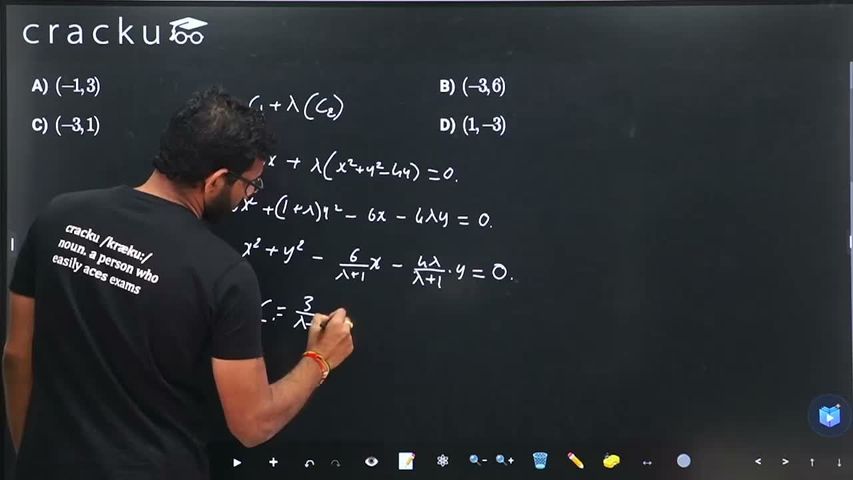
Click on the Email ☝️ to Watch the Video Solution
Create a FREE account and get:
_1.webp)

Educational materials for JEE preparation

Ask our AI anything

AI can make mistakes. Please verify important information.
AI can make mistakes. Please verify important information.


