
Join Our JEE Preparation Group
Prep with like-minded aspirants; Get access to free daily tests and study material.
Sign in
Please select an account to continue using cracku.in
↓ →
Join Our JEE Preparation Group
Prep with like-minded aspirants; Get access to free daily tests and study material.
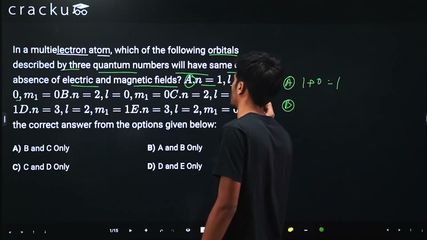
In a multielectron atom, which of the following orbitals described by three quantum numbers will have same energy in absence of electric and magnetic fields? $$A. n = 1, l = 0, m_{1}=0 B.n = 2,l = 0, m_{1}=0 C.n = 2,l = 1, m_{1}=1 D.n = 3,l = 2, m_{1} = 1 E.n = 3, l = 2, m_{1} = 0$$ Choose the correct answer from the options given below:
In a multi-electron atom (without external fields), we need to identify which orbitals have the same energy.
We start by recalling the energy ordering in multi-electron atoms. In multi-electron atoms, the energy of an orbital depends on both $$n$$ and $$l$$ (unlike hydrogen where it depends only on $$n$$). However, orbitals with the same $$n$$ and $$l$$ but different $$m_l$$ are degenerate (same energy) in the absence of external electric and magnetic fields.
Next, we identify the orbitals: A. $$n=1, l=0, m_l=0$$ — this is the $$1s$$ orbital; B. $$n=2, l=0, m_l=0$$ — this is the $$2s$$ orbital; C. $$n=2, l=1, m_l=1$$ — this is one of the $$2p$$ orbitals; D. $$n=3, l=2, m_l=1$$ — this is one of the $$3d$$ orbitals; E. $$n=3, l=2, m_l=0$$ — this is another $$3d$$ orbital.
Substituting these values, D and E both have $$n = 3$$ and $$l = 2$$ (both are $$3d$$ orbitals), differing only in $$m_l$$; they are degenerate. No other pair shares the same $$(n, l)$$ values.
The correct answer is Option D) D and E Only.
Was this solution helpful?
Click on the Email ☝️ to Watch the Video Solution
Create a FREE account and get:
_1.webp)

Educational materials for JEE preparation

Ask our AI anything

AI can make mistakes. Please verify important information.
AI can make mistakes. Please verify important information.
