
Join Our JEE Preparation Group
Prep with like-minded aspirants; Get access to free daily tests and study material.
Sign in
Please select an account to continue using cracku.in
↓ →
Join Our JEE Preparation Group
Prep with like-minded aspirants; Get access to free daily tests and study material.
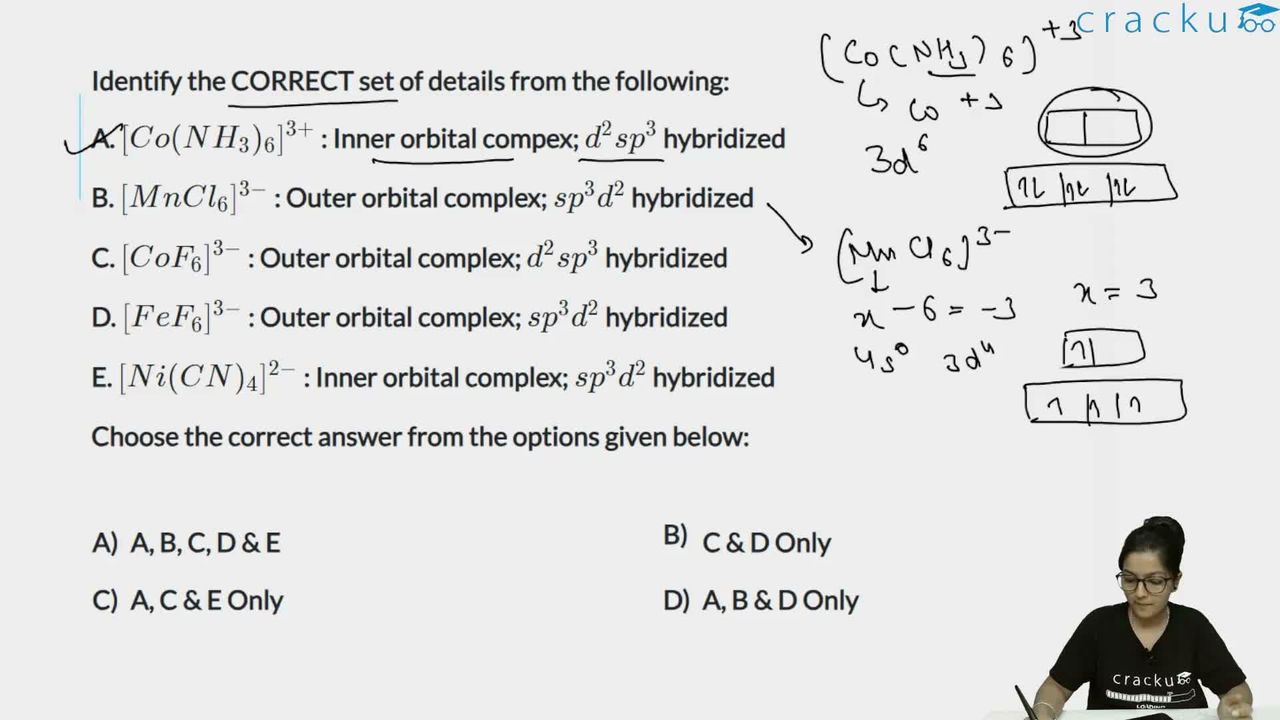
Identify the CORRECT set of details from the following:
A. $$[Co(NH_3)_6]^{3+}$$ : Inner orbital compex; $$d^{2}sp^{3}$$ hybridized
B. $$[MnCl_6]^{3-}$$ : Outer orbital complex; $$sp^{3}d^{2}$$ hybridized
C. $$[CoF_6]^{3-}$$ : Outer orbital complex; $$d^{2}sp^{3}$$ hybridized
D. $$[FeF_6]^{3-}$$ : Outer orbital complex; $$sp^{3}d^{2}$$ hybridized
E. $$[Ni(CN)_4]^{2-}$$ : Inner orbital complex; $$sp^{3}d^{2}$$ hybridized
Choose the correct answer from the options given below:
We need to identify which statements about coordination compounds are correct.
Statement A: $$[Co(NH_3)_6]^{3+}$$ — Inner orbital complex, $$d^2sp^3$$ hybridized.
Co in $$[Co(NH_3)_6]^{3+}$$: Co is $$\text{Co}^{3+}$$ with configuration $$3d^6$$. $$NH_3$$ is a strong field ligand, causing electron pairing. All 6 electrons pair up in three $$3d$$ orbitals, leaving two $$3d$$ orbitals empty. Hybridization: $$d^2sp^3$$ (using two inner 3d, one 4s, and three 4p orbitals). This is an inner orbital complex. Correct.
Statement B: $$[MnCl_6]^{3-}$$ — Outer orbital complex, $$sp^3d^2$$ hybridized.
Mn in $$[MnCl_6]^{3-}$$: Mn is $$\text{Mn}^{3+}$$ with configuration $$3d^4$$. $$Cl^-$$ is a weak field ligand, so no pairing occurs. With 4 unpaired electrons in the 3d orbitals, inner d orbitals are not available. Hybridization: $$sp^3d^2$$ (using 4s, 4p, and two 4d outer orbitals). This is an outer orbital complex. Correct.
Statement C: $$[CoF_6]^{3-}$$ — Outer orbital complex, $$d^2sp^3$$ hybridized.
Co in $$[CoF_6]^{3-}$$: $$\text{Co}^{3+}$$ with $$3d^6$$. $$F^-$$ is a weak field ligand, so electrons remain unpaired (4 unpaired electrons). Since inner d-orbitals are occupied, hybridization should be $$sp^3d^2$$ (outer orbital), not $$d^2sp^3$$. Incorrect — the hybridization is wrong.
Statement D: $$[FeF_6]^{3-}$$ — Outer orbital complex, $$sp^3d^2$$ hybridized.
Fe in $$[FeF_6]^{3-}$$: $$\text{Fe}^{3+}$$ with $$3d^5$$. $$F^-$$ is a weak field ligand — all five 3d electrons remain unpaired. No inner d orbitals available. Hybridization: $$sp^3d^2$$ (outer orbital). Correct.
Statement E: $$[Ni(CN)_4]^{2-}$$ — Inner orbital complex, $$sp^3d^2$$ hybridized.
Ni in $$[Ni(CN)_4]^{2-}$$: $$\text{Ni}^{2+}$$ with $$3d^8$$. $$CN^-$$ is a strong field ligand causing pairing: all 8 electrons pair in four 3d orbitals, leaving one 3d orbital empty. For 4 ligands, hybridization is $$dsp^2$$ (square planar), not $$sp^3d^2$$. Also $$sp^3d^2$$ implies 6 coordination, but there are only 4 ligands. Incorrect.
Conclusion: Statements A, B, and D are correct.
Hence the correct answer is Option 4: A, B & D Only.
Was this solution helpful?
Click on the Email ☝️ to Watch the Video Solution
Create a FREE account and get:
_1.webp)

Educational materials for JEE preparation

Ask our AI anything

AI can make mistakes. Please verify important information.
AI can make mistakes. Please verify important information.
