
Join Our JEE Preparation Group
Prep with like-minded aspirants; Get access to free daily tests and study material.
Sign in
Please select an account to continue using cracku.in
↓ →
Join Our JEE Preparation Group
Prep with like-minded aspirants; Get access to free daily tests and study material.
A compound 'X' on treatment with Br$$_2$$/NaOH, provided $$C_3H_9N$$, which gives positive carbylamine test. Compound X' is:
We notice at once that the reagent combination $$Br_2/NaOH$$ is the classical Hoffmann bromamide-degradation reagent. The very first fact we recall is the reaction itself:
$$RCONH_2 \;+\; Br_2 \;+\; 4\,NaOH \;\longrightarrow\; RNH_2 \;+\; 2\,NaBr \;+\; Na_2CO_3 \;+\; 2\,H_2O$$
The two most important points of this reaction are:
1. The product $$RNH_2$$ is a primary amine, because the nitrogen still possesses two hydrogens.
2. The carbonyl carbon (the C of the $$CONH_2$$ group) is lost as carbonate, so the amine formed has one carbon atom fewer than the original amide.
According to the question, the amine that actually forms has the molecular formula $$C_3H_9N$$ and it gives a positive carbylamine test, so it is indeed a primary amine. Therefore the starting amide must contain exactly one carbon atom more than this, i.e.
$$\text{Number of C in amide}=3+1=4$$
So we are looking for a compound with the formula $$C_4H_9NO$$ and, crucially, it must contain the functional group $$CONH_2$$ (so that it is a primary carboxamide).
Now we examine the four options one by one, keeping these two criteria in mind.
Option A: $$CH_3COCH_2NHCH_3$$
This molecule contains a $$CO$$ (ketone) group attached to the fragment $$NHCH_3$$, making it a secondary amine, not an amide. Hence it cannot undergo Hoffmann degradation in the required manner.
Option B: $$CH_3CH_2COCH_2NH_2$$
Again we have a ketone $$CO$$, this time adjacent to a primary amine. There is no $$CONH_2$$ moiety, so Hoffmann degradation is impossible.
Option C: $$CH_3CH_2CH_2CONH_2$$
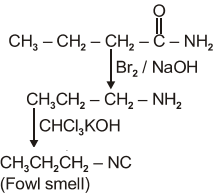
Here the functional group is clearly $$CONH_2$$, so the molecule is an amide, specifically butanamide. Let us count its atoms:
Carbons: $$3 \text{ (in }CH_3CH_2CH_2) + 1 \text{ (in }CONH_2)=4$$
Hydrogens: $$3+2+2+2=9$$
Nitrogen: $$1$$
Oxygen: $$1$$
Thus the empirical formula is $$C_4H_9NO$$, exactly what we require.
Applying the Hoffmann equation with $$R=CH_3CH_2CH_2-$$ we obtain
$$\bigl(CH_3CH_2CH_2CONH_2\bigr)+Br_2+4\,NaOH \;\longrightarrow\; CH_3CH_2CH_2NH_2+2\,NaBr+Na_2CO_3+2\,H_2O$$
The amine produced is $$CH_3CH_2CH_2NH_2$$, whose molecular formula is $$C_3H_9N$$, in complete agreement with the data.
Option D: $$CH_3CON(CH_3)_2$$
This molecule does contain a carbonyl attached to nitrogen, but the nitrogen bears no hydrogen; it is a tertiary amide. Hoffmann degradation strictly requires an $$NH_2$$ group on the carbonyl carbon, so this option is ruled out.
Among all the given structures, only Option C satisfies both the structural requirement (primary amide) and the carbon-count requirement (one carbon more than the amine).
Hence, the correct answer is Option C.
Was this solution helpful?
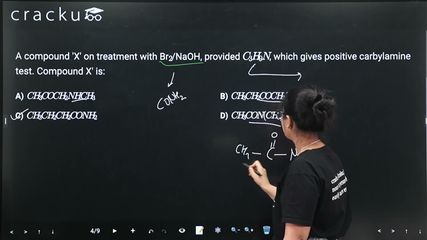
Click on the Email ☝️ to Watch the Video Solution
Create a FREE account and get:
_1.webp)

Educational materials for JEE preparation

Ask our AI anything

AI can make mistakes. Please verify important information.
AI can make mistakes. Please verify important information.


