
Join Our JEE Preparation Group
Prep with like-minded aspirants; Get access to free daily tests and study material.
Sign in
Please select an account to continue using cracku.in
↓ →
Join Our JEE Preparation Group
Prep with like-minded aspirants; Get access to free daily tests and study material.
If a hyperbola passes through the point P(10, 16), and it has vertices at ($$\pm$$6, 0), then the equation of the normal to it at P, is.
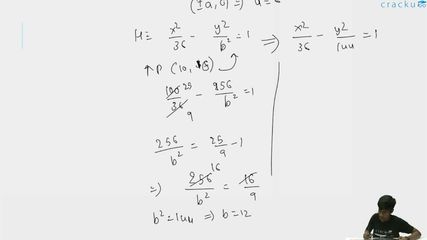
We have been told that the vertices of the hyperbola are at $$(\pm 6,0)$$. For a rectangular Cartesian frame whose origin is at the centre of the hyperbola and whose transverse axis lies along the $$x$$-axis, the standard form of a hyperbola is stated first as
$$\frac{x^{2}}{a^{2}}\;-\;\frac{y^{2}}{b^{2}} \;=\;1,$$
where $$a$$ is the semi-transverse axis. Because the vertices are at $$(\pm a,0)=(\pm 6,0)$$, we immediately identify $$a=6$$, so $$a^{2}=36$$. Thus for our curve the partially known equation is
$$\frac{x^{2}}{36}\;-\;\frac{y^{2}}{b^{2}} \;=\;1.$$
Now the point $$P(10,16)$$ lies on the hyperbola, so it must satisfy the equation. Substituting $$x=10$$ and $$y=16$$ gives
$$\frac{10^{2}}{36}\;-\;\frac{16^{2}}{b^{2}} \;=\;1.$$
Simplifying each term step by step, we get
$$\frac{100}{36}\;-\;\frac{256}{b^{2}} \;=\;1,$$
$$\frac{25}{9}\;-\;\frac{256}{b^{2}} \;=\;1.$$
Moving the second fraction to the right hand side and the constant $$1$$ to the left, we write
$$-\;\frac{256}{b^{2}} \;=\;1-\frac{25}{9},$$
$$-\;\frac{256}{b^{2}} \;=\;\frac{9}{9}-\frac{25}{9} \;=\;-\frac{16}{9}.$$
Removing the minus signs from both sides, we have
$$\frac{256}{b^{2}} \;=\;\frac{16}{9}.$$
Cross-multiplying gives
$$256 \times 9 \;=\;16\,b^{2},$$
$$b^{2} \;=\;\frac{256 \times 9}{16}.$$
Since $$256/16 = 16,$$ it follows that
$$b^{2}=16 \times 9 =144.$$
So the complete equation of the hyperbola is now fixed as
$$\frac{x^{2}}{36}\;-\;\frac{y^{2}}{144} \;=\;1.$$
To find the normal, we must first obtain the tangent at the given point. The general tangent to the hyperbola $$\dfrac{x^{2}}{a^{2}}-\dfrac{y^{2}}{b^{2}}=1$$ at a point $$(x_{1},y_{1})$$ on it is stated by the standard formula
$$\frac{xx_{1}}{a^{2}}\;-\;\frac{yy_{1}}{b^{2}} \;=\;1.$$
Using $$(x_{1},y_{1})=(10,16)$$ and $$a^{2}=36,\;b^{2}=144,$$ we substitute:
$$\frac{x\,(10)}{36}\;-\;\frac{y\,(16)}{144} \;=\;1.$$
Simplifying the numerical coefficients, we notice that
$$\frac{10}{36}=\frac{5}{18},\qquad \frac{16}{144}=\frac{1}{9},$$
so the tangent equation becomes
$$\frac{5x}{18}\;-\;\frac{y}{9} \;=\;1.$$
To obtain a simpler linear form, multiply every term by $$18$$:
$$5x\;-\;2y \;=\;18.$$
Writing this line in the slope-intercept form $$y=mx+c$$, we shift terms:
$$-\,2y = 18-5x,$$
$$2y = 5x-18,$$
$$y = \frac{5}{2}\,x - 9.$$
Thus the slope of the tangent is
$$m_{\text{tangent}} = \frac{5}{2}.$$
For the normal, we use the fact that the product of the slopes of a line and its normal is $$-1$$. Therefore, stating the relation $$m_{\text{tangent}}\;m_{\text{normal}} = -1,$$ we find
$$m_{\text{normal}} = -\,\frac{1}{m_{\text{tangent}}} = -\,\frac{1}{\frac{5}{2}} = -\,\frac{2}{5}.$$
Finally, we write the equation of the normal passing through $$P(10,16)$$ with slope $$-\dfrac{2}{5}$$ using the point-slope form $$y - y_{1} = m(x - x_{1})$$:
$$y - 16 = -\,\frac{2}{5}\,(x - 10).$$
Multiplying by $$5$$ to clear the denominator, we obtain
$$5(y - 16) = -2(x - 10),$$
$$5y - 80 = -2x + 20.$$
Collecting terms on one side, we write
$$2x + 5y - 100 = 0.$$
Or, presenting it more cleanly,
$$2x + 5y = 100.$$
This matches the option offered as $$2x + 5y = 100$$.
Hence, the correct answer is Option B.
Was this solution helpful?
Click on the Email ☝️ to Watch the Video Solution
Create a FREE account and get:
_1.webp)

Educational materials for JEE preparation

Ask our AI anything

AI can make mistakes. Please verify important information.
AI can make mistakes. Please verify important information.


