
Join Our JEE Preparation Group
Prep with like-minded aspirants; Get access to free daily tests and study material.
Sign in
Please select an account to continue using cracku.in
↓ →
Join Our JEE Preparation Group
Prep with like-minded aspirants; Get access to free daily tests and study material.
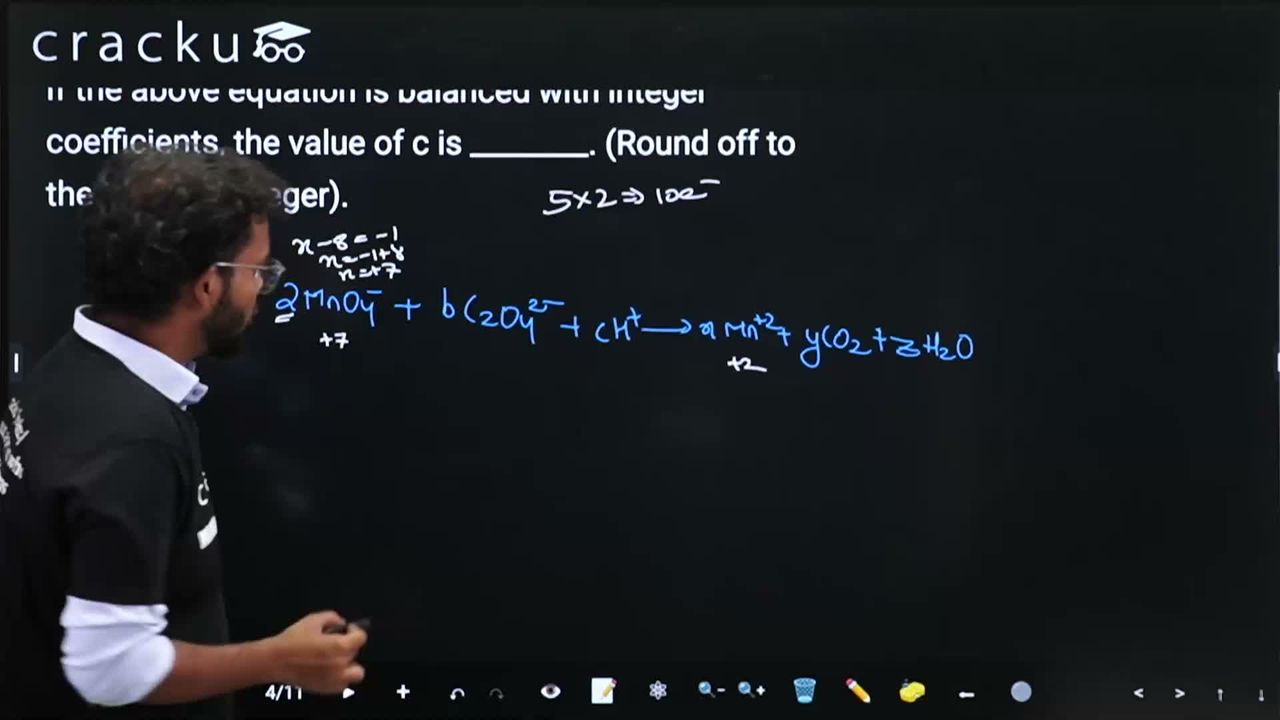
$$2MnO_4^- + bC_2O_4^{2-} + cH^+ \rightarrow xMn^{2+} + yCO_2 + zH_2O$$
If the above equation is balanced with integer coefficients, the value of c is ________. (Round off to the Nearest Integer).
Correct Answer: 16
We need to balance the redox equation: $$2MnO_4^- + bC_2O_4^{2-} + cH^+ \rightarrow xMn^{2+} + yCO_2 + zH_2O$$.
In the permanganate ion, Mn is in the +7 oxidation state, and it is reduced to $$Mn^{2+}$$ (oxidation state +2). The change in oxidation state per Mn atom is $$7 - 2 = 5$$. Since there are 2 $$MnO_4^-$$ ions, the total electron gain is $$2 \times 5 = 10$$ electrons.
In the oxalate ion $$C_2O_4^{2-}$$, carbon has an oxidation state of +3. In $$CO_2$$, carbon has an oxidation state of +4. Each carbon atom loses 1 electron, and each oxalate ion has 2 carbon atoms, so each oxalate ion loses 2 electrons.
For electron balance: total electrons lost = total electrons gained. So $$2b = 10$$, giving $$b = 5$$.
Now we can determine the other coefficients. Balancing carbon: $$2 \times 5 = y$$, so $$y = 10$$. Balancing Mn: $$x = 2$$. Balancing oxygen: left side has $$2 \times 4 + 5 \times 4 = 8 + 20 = 28$$ oxygen atoms; right side has $$10 \times 2 + z = 20 + z$$. So $$z = 8$$.
Balancing hydrogen: $$c = 2z = 16$$.
Let us verify the charge balance. Left side: $$2(-1) + 5(-2) + 16(+1) = -2 - 10 + 16 = +4$$. Right side: $$2(+2) = +4$$. The charges balance.
The balanced equation is $$2MnO_4^- + 5C_2O_4^{2-} + 16H^+ \rightarrow 2Mn^{2+} + 10CO_2 + 8H_2O$$.
Therefore, the value of $$c$$ is $$\mathbf{16}$$.
Click on the Email ☝️ to Watch the Video Solution
Create a FREE account and get:
_1.webp)

Educational materials for JEE preparation

Ask our AI anything

AI can make mistakes. Please verify important information.
AI can make mistakes. Please verify important information.


