
Join Our JEE Preparation Group
Prep with like-minded aspirants; Get access to free daily tests and study material.
Sign in
Please select an account to continue using cracku.in
↓ →
Join Our JEE Preparation Group
Prep with like-minded aspirants; Get access to free daily tests and study material.
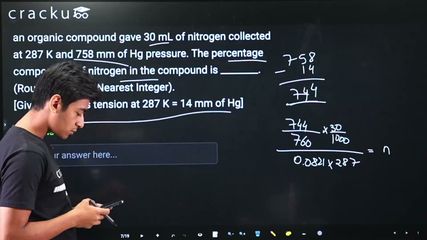
In Duma's method of estimation of nitrogen, 0.1840 g of an organic compound gave 30 mL of nitrogen collected at 287 K and 758 mm of Hg pressure. The percentage composition of nitrogen in the compound is ________. (Round off to the Nearest Integer).
[Given: Aqueous tension at 287 K = 14 mm of Hg]
Correct Answer: 19
In Duma's method, nitrogen in the organic compound is converted to $$N_2$$ gas, which is collected over water. We need to correct for the aqueous tension (water vapour pressure).
The pressure of dry nitrogen gas is: $$P_{N_2} = P_{total} - P_{water} = 758 - 14 = 744$$ mm of Hg.
Using the ideal gas law to find moles of $$N_2$$: $$n = \frac{PV}{RT}$$, where $$P = \frac{744}{760}$$ atm $$= 0.9789$$ atm, $$V = \frac{30}{1000}$$ L $$= 0.030$$ L, $$R = 0.0821$$ L atm mol$$^{-1}$$ K$$^{-1}$$, and $$T = 287$$ K.
$$n = \frac{0.9789 \times 0.030}{0.0821 \times 287} = \frac{0.029368}{23.5627} = 1.2463 \times 10^{-3}$$ mol.
Mass of nitrogen = $$1.2463 \times 10^{-3} \times 28 = 0.03490$$ g.
Percentage of nitrogen = $$\frac{0.03490}{0.1840} \times 100 = 18.97\%$$.
Rounding off to the nearest integer, the percentage composition of nitrogen is $$19$$.
Was this solution helpful?
Click on the Email ☝️ to Watch the Video Solution
Create a FREE account and get:
_1.webp)

Educational materials for JEE preparation

Ask our AI anything

AI can make mistakes. Please verify important information.
AI can make mistakes. Please verify important information.
