
Join Our JEE Preparation Group
Prep with like-minded aspirants; Get access to free daily tests and study material.
Sign in
Please select an account to continue using cracku.in
↓ →
Join Our JEE Preparation Group
Prep with like-minded aspirants; Get access to free daily tests and study material.
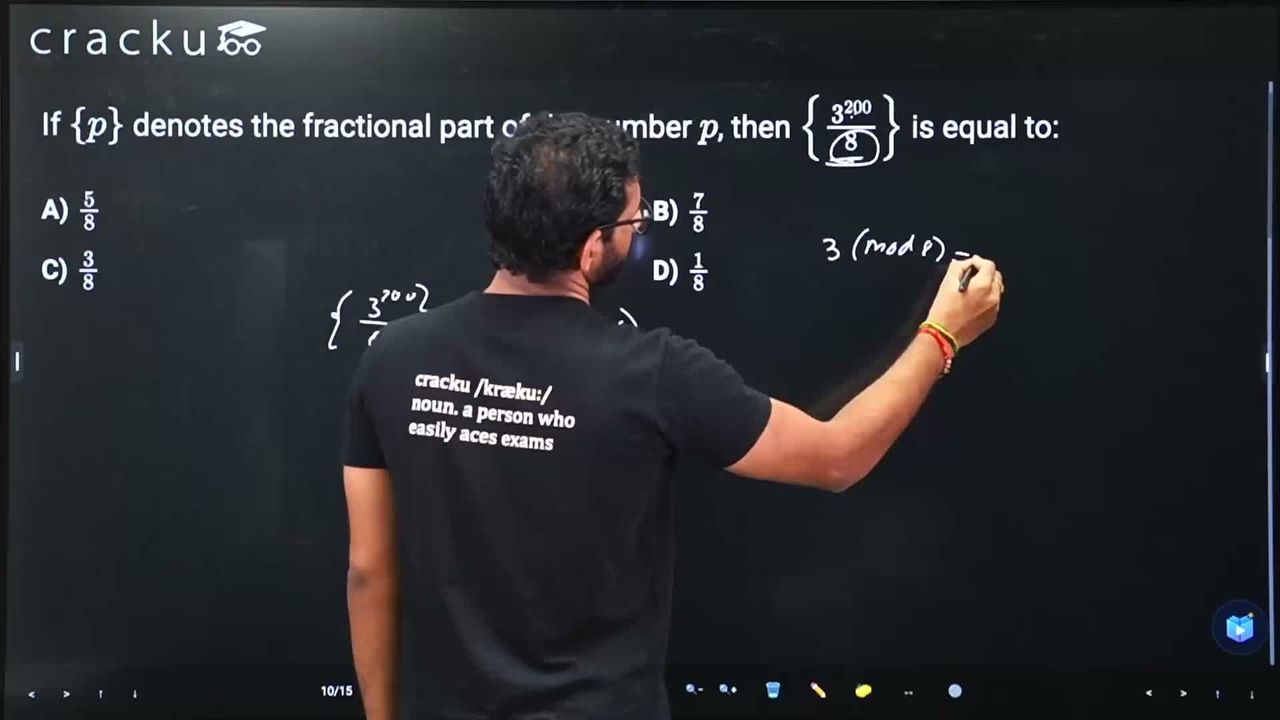
If $$\{p\}$$ denotes the fractional part of the number $$p$$, then $$\left\{\frac{3^{200}}{8}\right\}$$ is equal to:
We recall that for any real number $$x$$, its fractional part is defined by the formula $$\{x\}=x-\lfloor x\rfloor$$, where $$\lfloor x\rfloor$$ is the greatest integer less than or equal to $$x$$.
We need $$\left\{\dfrac{3^{200}}{8}\right\}$$. To isolate the fractional part, it is convenient to know how $$3^{200}$$ behaves when divided by $$8$$. For this purpose we look at remainders, that is, we work “modulo 8”.
We start examining small powers of $$3$$ modulo $$8$$:
$$3^{1}=3\equiv3\pmod{8},$$
$$3^{2}=9\equiv9-8=1\pmod{8}.$$
Now $$3^{3}=3^{2}\cdot3\equiv1\cdot3=3\pmod{8},$$
and $$3^{4}=(3^{2})^{2}\equiv1^{2}=1\pmod{8}.$$
We see the alternating pattern $$3,1,3,1,\dots$$. In particular, every even power of $$3$$ leaves a remainder of $$1$$ upon division by $$8$$. Because $$200$$ is even, we have
$$3^{200}\equiv1\pmod{8}.$$
This congruence means there exists some integer $$k$$ such that
$$3^{200}=8k+1.$$
We now divide both sides by $$8$$:
$$\dfrac{3^{200}}{8}=k+\dfrac{1}{8}.$$
Here $$k$$ is an integer, so by the definition of fractional part,
$$\left\{\dfrac{3^{200}}{8}\right\}=\dfrac{1}{8}.$$
Hence, the correct answer is Option D.
Click on the Email ☝️ to Watch the Video Solution
Create a FREE account and get:
_1.webp)

Educational materials for JEE preparation

Ask our AI anything

AI can make mistakes. Please verify important information.
AI can make mistakes. Please verify important information.


