JEE WhatsApp Group
Sign in
Please select an account to continue using cracku.in
↓ →
JEE WhatsApp Group

Join Our JEE Preparation Group
Prep with like-minded aspirants; Get access to free daily tests and study material.
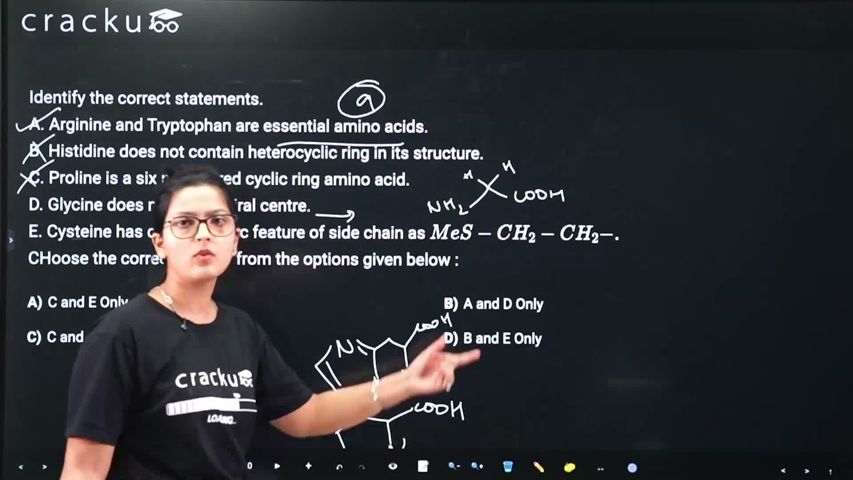
Identify the correct statements.
A. Arginine and Tryptophan are essential amino acids.
B. Histidine does not contain heterocyclic ring in its structure.
C. Proline is a six membered cyclic ring amino acid.
D. Glycine does not have chiral centre.
E. Cysteine has characteristic feature of side chain as $$MeS-CH_{2}-CH_{2}-.$$
CHoose the correct answer from the options given below :
We need to identify the correct statements about amino acids.
A. Arginine and Tryptophan are essential amino acids.
CORRECT. Both arginine and tryptophan are among the essential amino acids that cannot be synthesized by the human body and must be obtained from the diet.
B. Histidine does not contain a heterocyclic ring in its structure.
INCORRECT. Histidine contains an imidazole ring (a five-membered heterocyclic ring containing two nitrogen atoms) in its side chain.
C. Proline is a six-membered cyclic ring amino acid.
INCORRECT. Proline has a five-membered pyrrolidine ring (not six-membered), where the side chain is cyclically bonded to the nitrogen atom of the amino group.
D. Glycine does not have a chiral centre.
CORRECT. Glycine ($$H_2N\text{-}CH_2\text{-}COOH$$) has two hydrogen atoms on the $$\alpha$$-carbon, making it achiral. It is the only amino acid without a chiral center.
E. Cysteine has a characteristic feature of side chain as $$MeS\text{-}CH_2\text{-}CH_2\text{-}$$.
INCORRECT. Cysteine has the side chain $$HS\text{-}CH_2\text{-}$$ (a thiol/sulfhydryl group), not $$MeS\text{-}CH_2\text{-}CH_2\text{-}$$. The description given matches methionine, not cysteine.
Correct statements: A and D only.
The correct answer is Option (2): A and D only.
Click on the Email ☝️ to Watch the Video Solution
Create a FREE account and get:
_1.webp)

Educational materials for JEE preparation

Ask our AI anything

AI can make mistakes. Please verify important information.
AI can make mistakes. Please verify important information.