
Join Our JEE Preparation Group
Prep with like-minded aspirants; Get access to free daily tests and study material.
Sign in
Please select an account to continue using cracku.in
↓ →
Join Our JEE Preparation Group
Prep with like-minded aspirants; Get access to free daily tests and study material.
Which of the following f-block elements in the +3 oxidation state is colourless?
1. $$\mathrm{La^{3+}}$$
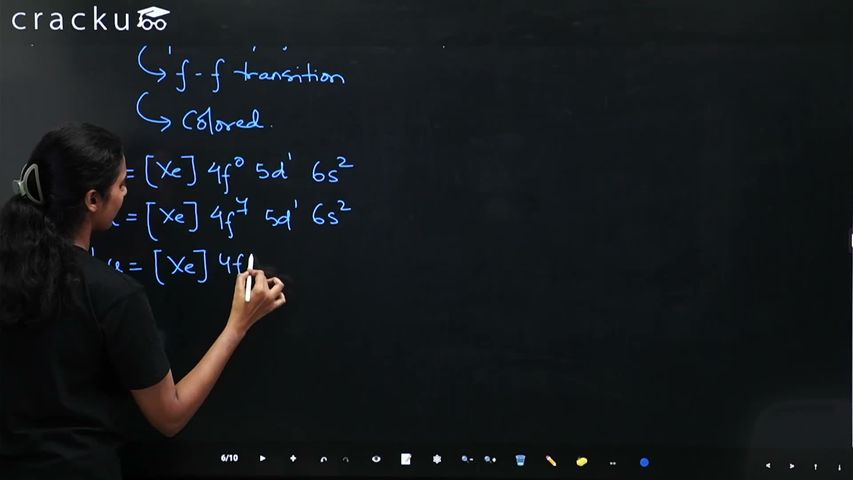
- Configuration: $$[\mathrm{Xe}]\,4f^0$$
- Reason: It has an empty $$f$$-subshell. Without electrons, no $$f\text{-}f$$ transitions can occur to absorb visible light.
2. $$\mathrm{Gd^{3+}}$$
- Configuration: $$[\mathrm{Xe}]\,4f^7$$
- Reason: It has a half-filled $$f$$-subshell. Its electronic transitions absorb mainly in the ultraviolet region, leaving it colourless in the visible spectrum.
3. $$\mathrm{Lu^{3+}}$$
- Configuration: $$[\mathrm{Xe}]\,4f^{14}$$
- Reason: It has a completely filled $$f$$-subshell. There are no vacant orbitals available for $$f\text{-}f$$ electronic transitions.
Correct option: (D)
Was this solution helpful?
Click on the Email ☝️ to Watch the Video Solution
Create a FREE account and get:
Educational materials for JEE preparation

Ask our AI anything

AI can make mistakes. Please verify important information.
AI can make mistakes. Please verify important information.

_1.webp)
