
Join Our JEE Preparation Group
Prep with like-minded aspirants; Get access to free daily tests and study material.
Sign in
Please select an account to continue using cracku.in
↓ →
Join Our JEE Preparation Group
Prep with like-minded aspirants; Get access to free daily tests and study material.
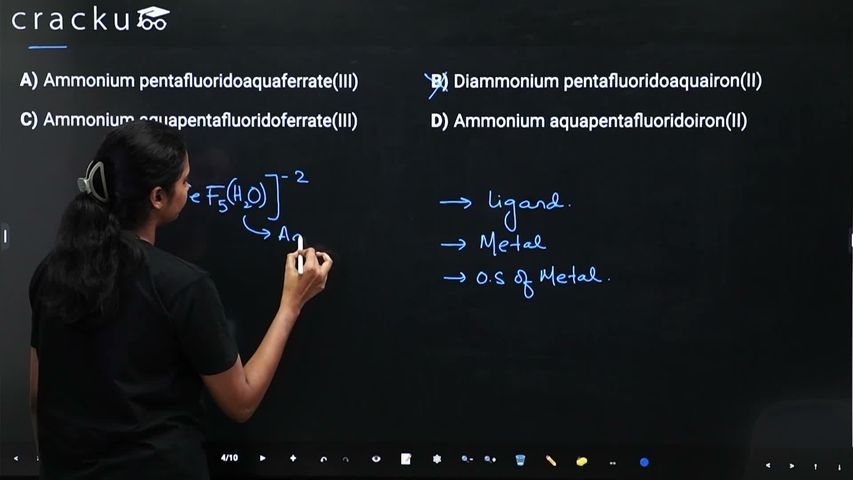
Which of the following is the correct IUPAC name of the given coordination compound?
$$\mathrm{(NH_4)_2[FeF_5(H_2O)]}$$
Nomenclature of coordinate compounds:
1.Order: Name the cation first, then the anion.
2.Ligands: List ligands alphabetically before the metal.
3.Prefixes: Use di-, tri-, tetra-, penta- for ligand quantities.
4.Anionic Complex: Add -ate to the metal name if the complex is negative.
5.Oxidation State: Write the metal's charge in Roman numerals at the end.
- Cation: Ammonium $$\mathrm{NH_4^+}$$ is named first as a separate word.
- Ligands (in alphabetical order):
- aquao or aqua $$\mathrm{H_2O}$$
- pentafluoro or pentafluorido $$5\times\mathrm{F^-}$$
- Central Metal: Because the complex ion $$\mathrm{[FeF_5(H_2O)]^{2-}}$$ carries a negative charge, the suffix -ate is appended to the Latin stem of the metal (ferrum), making it ferrate.
- Oxidation State: Calculated as +3 and written in Roman numerals:
$$\text{Oxidation State}=x+5(-1)+1(0)=-2\implies x=+3$$
Correct option: (C)
Was this solution helpful?
Click on the Email ☝️ to Watch the Video Solution
Create a FREE account and get:
_1.webp)

Educational materials for JEE preparation

Ask our AI anything

AI can make mistakes. Please verify important information.
AI can make mistakes. Please verify important information.
