
Join Our JEE Preparation Group
Prep with like-minded aspirants; Get access to free daily tests and study material.
Sign in
Please select an account to continue using cracku.in
↓ →
Join Our JEE Preparation Group
Prep with like-minded aspirants; Get access to free daily tests and study material.
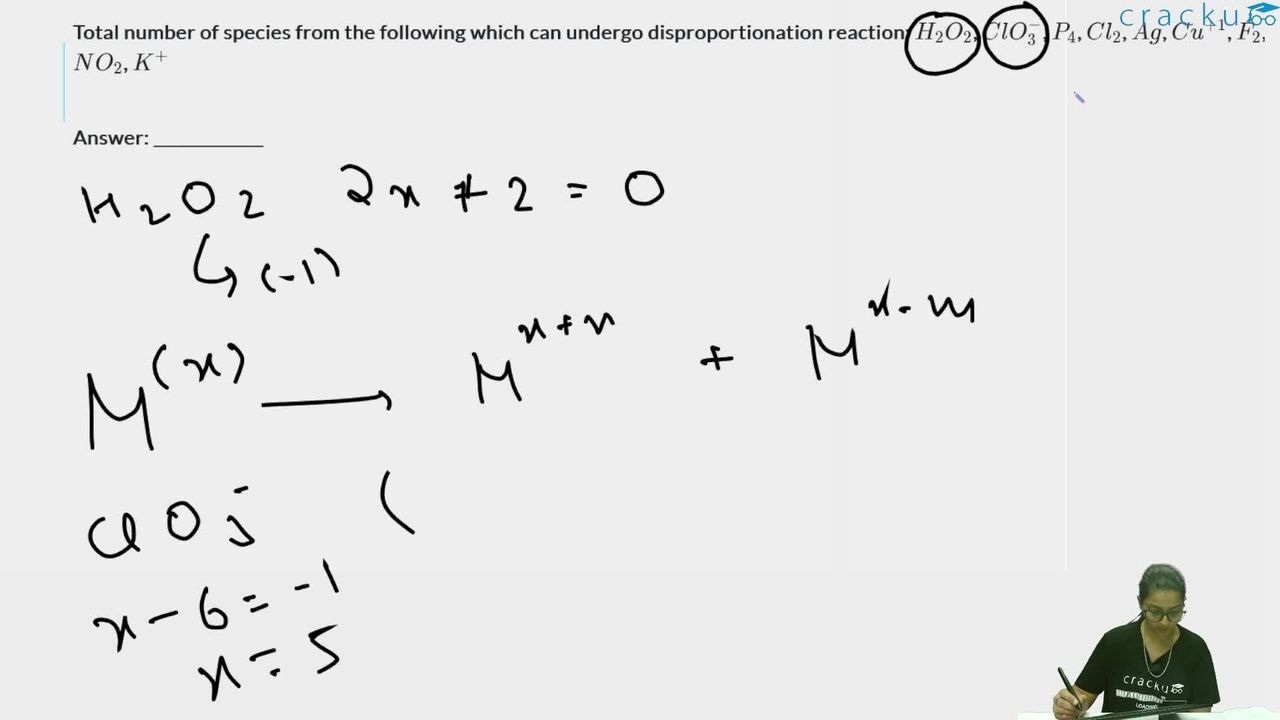
Total number of species from the following which can undergo disproportionation reaction: $$H_2O_2$$, $$ClO_3^-$$, $$P_4$$, $$Cl_2$$, $$Ag$$, $$Cu^{+1}$$, $$F_2$$, $$NO_2$$, $$K^+$$
Correct Answer: 6
Species that can undergo disproportionation have an element in an intermediate oxidation state:
$$H_2O_2$$: O is in -1 state (can go to 0 and -2) — YES
$$ClO_3^-$$: Cl is in +5 — YES (can disproportionate)
$$P_4$$: P is in 0 state — YES (goes to -3 and +5 in alkali)
$$Cl_2$$: Cl is in 0 state — YES (goes to -1 and +1)
$$Ag$$: metallic, 0 state — NO (already in lowest practical state)
$$Cu^{+1}$$: Can go to Cu(0) and Cu(+2) — YES
$$F_2$$: F is in 0 state, but F only goes to -1 (no positive states) — NO
$$NO_2$$: N is in +4 — YES (goes to +5 and +3)
$$K^+$$: Cannot disproportionate — NO
Total = 6 (H$$_2$$O$$_2$$, ClO$$_3^-$$, P$$_4$$, Cl$$_2$$, Cu$$^{+1}$$, NO$$_2$$).
Therefore, the answer is $$\boxed{6}$$.
Was this solution helpful?
Click on the Email ☝️ to Watch the Video Solution
Create a FREE account and get:
_1.webp)

Educational materials for JEE preparation

Ask our AI anything

AI can make mistakes. Please verify important information.
AI can make mistakes. Please verify important information.
