
Join Our JEE Preparation Group
Prep with like-minded aspirants; Get access to free daily tests and study material.
Sign in
Please select an account to continue using cracku.in
↓ →
Join Our JEE Preparation Group
Prep with like-minded aspirants; Get access to free daily tests and study material.
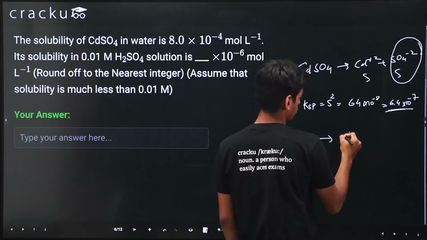
The solubility of CdSO$$_4$$ in water is $$8.0 \times 10^{-4}$$ mol L$$^{-1}$$. Its solubility in 0.01 M H$$_2$$SO$$_4$$ solution is ___ $$\times 10^{-6}$$ mol L$$^{-1}$$ (Round off to the Nearest integer) (Assume that solubility is much less than 0.01 M)
Correct Answer: 64
$$\text{CdSO}_4$$ dissociates as $$\text{CdSO}_4 \rightleftharpoons \text{Cd}^{2+} + \text{SO}_4^{2-}$$. In pure water the solubility is $$s = 8.0 \times 10^{-4}$$ mol/L, so the solubility product is $$K_{sp} = s \times s = s^2 = (8.0 \times 10^{-4})^2 = 6.4 \times 10^{-7}$$.
In 0.01 M $$\text{H}_2\text{SO}_4$$ solution, the sulphate ion concentration from the acid is $$[\text{SO}_4^{2-}] = 0.01$$ M (since $$\text{H}_2\text{SO}_4$$ is a strong acid that fully dissociates). Let the solubility of $$\text{CdSO}_4$$ in this solution be $$s'$$. Since $$s' \ll 0.01$$ M (as given), the total sulphate concentration is approximately 0.01 M.
Applying the solubility product expression: $$K_{sp} = s' \times (0.01 + s') \approx s' \times 0.01$$. Therefore $$s' = \frac{K_{sp}}{0.01} = \frac{6.4 \times 10^{-7}}{10^{-2}} = 6.4 \times 10^{-5} = 64 \times 10^{-6}$$ mol/L.
The answer is $$64$$.
Was this solution helpful?
Click on the Email ☝️ to Watch the Video Solution
Create a FREE account and get:
_1.webp)

Educational materials for JEE preparation

Ask our AI anything

AI can make mistakes. Please verify important information.
AI can make mistakes. Please verify important information.
