
Join Our JEE Preparation Group
Prep with like-minded aspirants; Get access to free daily tests and study material.
Sign in
Please select an account to continue using cracku.in
↓ →
Join Our JEE Preparation Group
Prep with like-minded aspirants; Get access to free daily tests and study material.
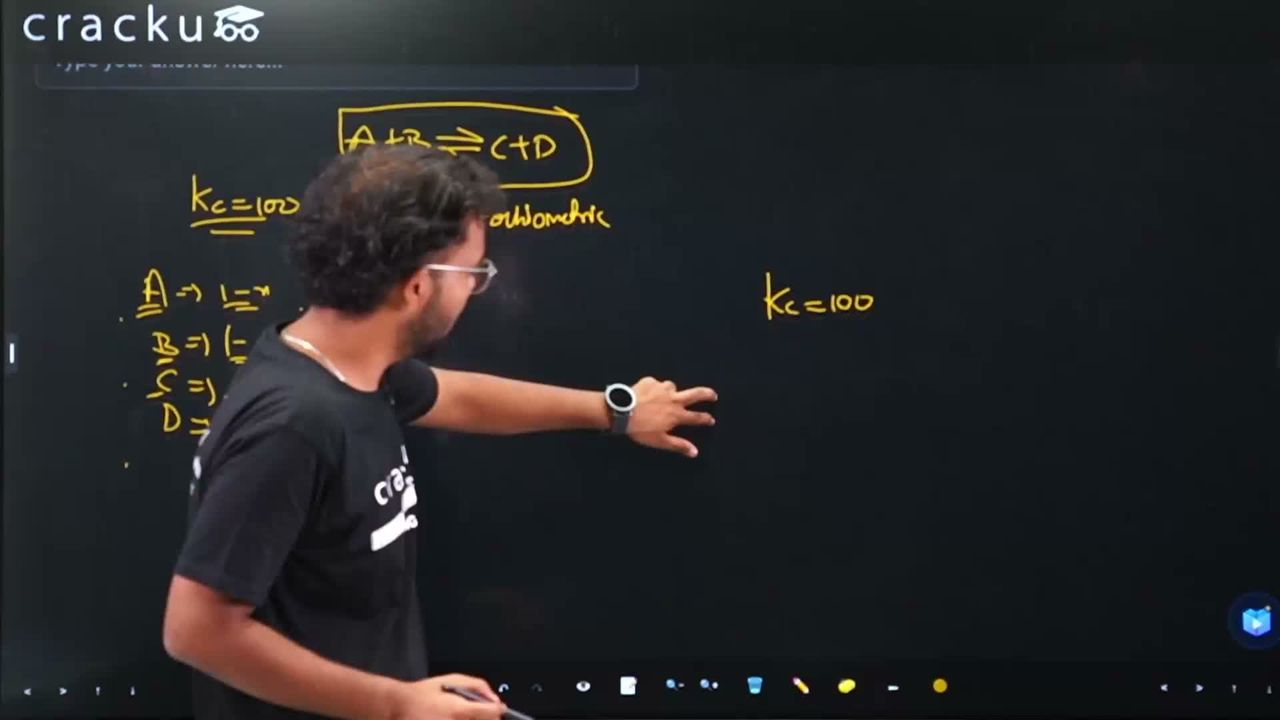
The equilibrium constant $$K_c$$ at 298 K for the reaction A + B $$\rightleftharpoons$$ C + D is 100. Starting with an equimolar solution with concentrations of A, B, C and D all equal to 1M, the equilibrium concentration of D is _________ $$\times 10^{-2}$$ M. (Nearest integer)
Correct Answer: 182
We have the homogeneous gaseous reaction
$$\mathrm{A + B \rightleftharpoons C + D}$$
The equilibrium constant at 298 K is given as
$$K_c = 100.$$
Initially all four species are present in equal molar concentration, viz.
$$[\mathrm A]_0 = [\mathrm B]_0 = [\mathrm C]_0 = [\mathrm D]_0 = 1\ \text{M}.$$
The reaction quotient at the start is therefore
$$Q_0 = \frac{[\mathrm C]_0[\mathrm D]_0}{[\mathrm A]_0[\mathrm B]_0} = \frac{1 \times 1}{1 \times 1} = 1.$$
Because $$K_c = 100 > Q_0 = 1,$$ the reaction must proceed in the forward direction so that more products (C and D) are formed until equilibrium is reached.
Let $$x\ \text{M}$$ of A and the same amount of B be consumed. By stoichiometry the same $$x\ \text{M}$$ of C and of D will be produced. Hence the concentrations at equilibrium become
$$[\mathrm A]_{eq} = 1 - x,$$
$$[\mathrm B]_{eq} = 1 - x,$$
$$[\mathrm C]_{eq} = 1 + x,$$
$$[\mathrm D]_{eq} = 1 + x.$$
We now impose the definition of the equilibrium constant:
$$K_c = \frac{[\mathrm C]_{eq}[\mathrm D]_{eq}} {[\mathrm A]_{eq}[\mathrm B]_{eq}} = \frac{(1 + x)(1 + x)}{(1 - x)(1 - x)} = \left(\frac{1 + x}{1 - x}\right)^2.$$
Substituting the given value $$K_c = 100$$ we get
$$100 = \left(\frac{1 + x}{1 - x}\right)^2.$$
Taking the positive square root (concentrations must stay positive)
$$\sqrt{100} = 10 = \frac{1 + x}{1 - x}.$$
Now we solve this linear equation for $$x$$:
$$10(1 - x) = 1 + x,$$
$$10 - 10x = 1 + x,$$
$$10 - 1 = x + 10x,$$
$$9 = 11x,$$
$$x = \frac{9}{11}\ \text{M} \approx 0.818181\ \text{M}.$$
Therefore the equilibrium concentration of D is
$$[\mathrm D]_{eq} = 1 + x = 1 + \frac{9}{11} = \frac{20}{11}\ \text{M} \approx 1.818181\ \text{M}.$$
The problem asks for this value in the form $$\;n \times 10^{-2}\ \text{M}.$$
We convert as follows:
$$[\mathrm D]_{eq} = 1.818181\ \text{M} = 1.818181 \times 10^{0}\ \text{M} = 181.8181 \times 10^{-2}\ \text{M}.$$
The nearest integer to $$181.8181$$ is $$182.$$ Hence, the correct answer is Option 182.
Was this solution helpful?
Click on the Email ☝️ to Watch the Video Solution
Create a FREE account and get:
_1.webp)

Educational materials for JEE preparation

Ask our AI anything

AI can make mistakes. Please verify important information.
AI can make mistakes. Please verify important information.
