
Join Our JEE Preparation Group
Prep with like-minded aspirants; Get access to free daily tests and study material.
Sign in
Please select an account to continue using cracku.in
↓ →
Join Our JEE Preparation Group
Prep with like-minded aspirants; Get access to free daily tests and study material.
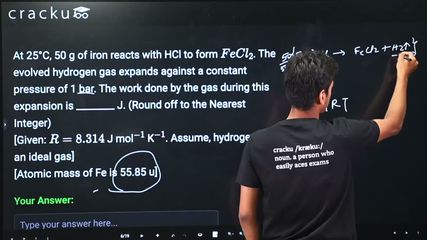
At 25°C, 50 g of iron reacts with HCl to form $$FeCl_2$$. The evolved hydrogen gas expands against a constant pressure of 1 bar. The work done by the gas during this expansion is ________ J. (Round off to the Nearest Integer)
[Given: $$R = 8.314$$ J mol$$^{-1}$$ K$$^{-1}$$. Assume, hydrogen is an ideal gas]
[Atomic mass of Fe is 55.85 u]
Correct Answer: 2218
The reaction of iron with hydrochloric acid is: $$Fe + 2HCl \rightarrow FeCl_2 + H_2 \uparrow$$.
Moles of iron = $$\frac{50}{55.85} = 0.8953$$ mol. Since each mole of iron produces one mole of hydrogen gas, moles of $$H_2$$ produced = $$0.8953$$ mol.
The work done by the gas expanding against a constant external pressure of 1 bar is given by $$W = nRT$$ (for an ideal gas expanding at constant pressure where $$\Delta n_{gas} = n$$, since the reactants are in condensed/solution phase).
At 25°C (298 K): $$W = nRT = 0.8953 \times 8.314 \times 298 = 2218.1$$ J.
Alternatively, using $$W = P\Delta V = P \cdot nRT/P = nRT$$, we get the same result since the initial volume of gas is zero and the final volume is $$V = nRT/P$$.
The work done by the gas during this expansion is $$2218$$ J.
Click on the Email ☝️ to Watch the Video Solution
Create a FREE account and get:
_1.webp)

Educational materials for JEE preparation

Ask our AI anything

AI can make mistakes. Please verify important information.
AI can make mistakes. Please verify important information.


