
Join Our JEE Preparation Group
Prep with like-minded aspirants; Get access to free daily tests and study material.
Sign in
Please select an account to continue using cracku.in
↓ →
Join Our JEE Preparation Group
Prep with like-minded aspirants; Get access to free daily tests and study material.
1 mole of PbS is oxidised by X moles of $$O_3$$ to get Y moles of $$O_2$$. X + Y =
Correct Answer: 8
We apply the oxidation number method to balance the redox reaction between lead sulfide and ozone.
Step 1: Oxidation half‐reaction
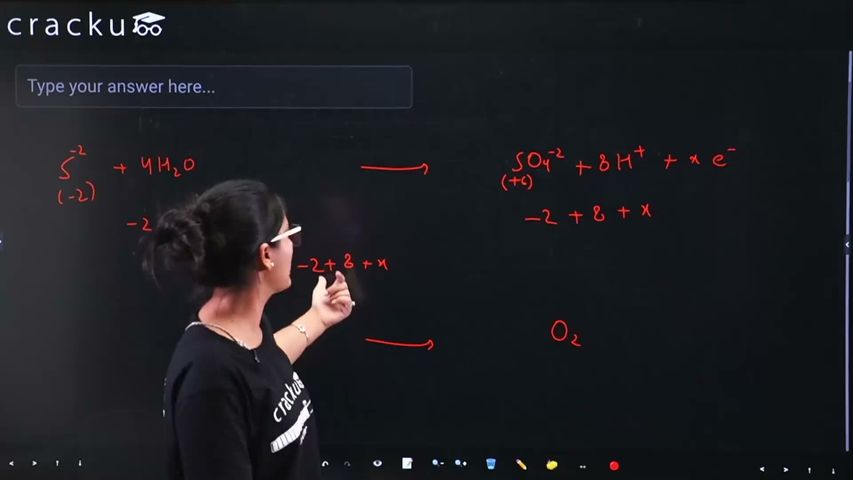
Sulfur in $$PbS$$ changes its oxidation state from $$-2$$ to $$+6$$ in $$SO_4^{2-}$$. In acidic medium the half‐reaction is written as:
$$S^{2-} + 4\,H_2O \;\longrightarrow\; SO_4^{2-} + 8\,H^+ + 8\,e^-$$ $$-(1)$$
Step 2: Reduction half‐reaction
Ozone is reduced to oxygen, with each oxygen atom remaining at oxidation state $$0$$. The half‐reaction in acidic medium is:
$$O_3 + 2\,H^+ + 2\,e^- \;\longrightarrow\; O_2 + H_2O$$ $$-(2)$$
Step 3: Equalize electrons
The oxidation half‐reaction (1) involves 8 electrons, while the reduction half‐reaction (2) involves 2 electrons. To balance electrons, multiply equation (2) by 4:
$$4\,O_3 + 8\,H^+ + 8\,e^- \;\longrightarrow\; 4\,O_2 + 4\,H_2O$$ $$-(3)$$
Step 4: Add half‐reactions
Adding equations (1) and (3) and cancelling common species ($$8\,e^-$$, $$8\,H^+$$ and $$4\,H_2O$$) gives:
$$S^{2-} + 4\,O_3 \;\longrightarrow\; SO_4^{2-} + 4\,O_2$$ $$-(4)$$
Step 5: Include lead ion
Since the sulfide ion comes from $$PbS$$ and the sulfate ion forms $$PbSO_4$$, we combine with $$Pb^{2+}$$ to get the overall equation:
$$PbS + 4\,O_3 \;\longrightarrow\; PbSO_4 + 4\,O_2$$ $$-(5)$$
From the balanced equation (5), 1 mole of $$PbS$$ reacts with $$X=4$$ moles of $$O_3$$ to produce $$Y=4$$ moles of $$O_2$$. Therefore,
$$X + Y = 4 + 4 = 8$$
Was this solution helpful?
Click on the Email ☝️ to Watch the Video Solution
Create a FREE account and get:
_1.webp)

Educational materials for JEE preparation

Ask our AI anything

AI can make mistakes. Please verify important information.
AI can make mistakes. Please verify important information.
