
Join Our JEE Preparation Group
Prep with like-minded aspirants; Get access to free daily tests and study material.
Sign in
Please select an account to continue using cracku.in
↓ →
Join Our JEE Preparation Group
Prep with like-minded aspirants; Get access to free daily tests and study material.
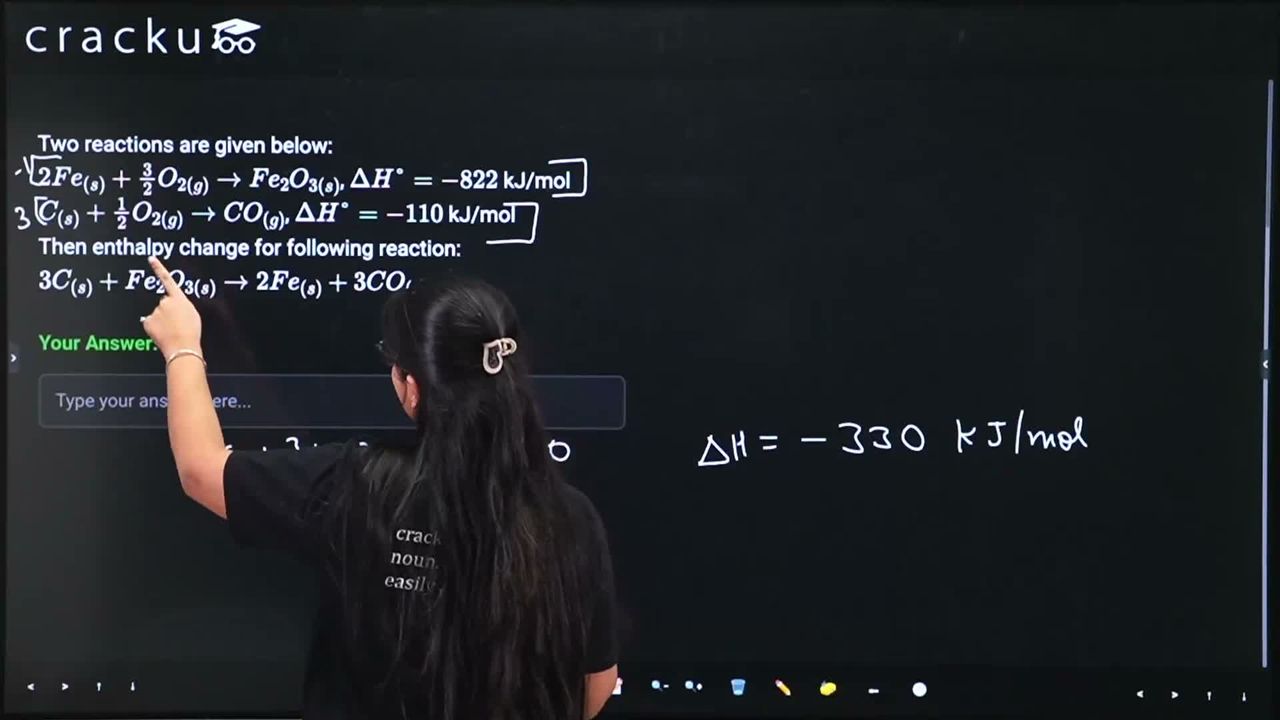
Two reactions are given below:
$$2Fe_{(s)} + \frac{3}{2}O_{2(g)} \rightarrow Fe_2O_{3(s)}$$, $$\Delta H° = -822$$ kJ/mol
$$C_{(s)} + \frac{1}{2}O_{2(g)} \rightarrow CO_{(g)}$$, $$\Delta H° = -110$$ kJ/mol
Then enthalpy change for following reaction:
$$3C_{(s)} + Fe_2O_{3(s)} \rightarrow 2Fe_{(s)} + 3CO_{(g)}$$
Correct Answer: 492
We need to find the enthalpy change for the reaction:
$$ 3C_{(s)} + Fe_2O_{3(s)} \rightarrow 2Fe_{(s)} + 3CO_{(g)} $$
We are given two reactions:
The first is $$2Fe_{(s)} + \frac{3}{2}O_{2(g)} \rightarrow Fe_2O_{3(s)}$$, $$\Delta H_1° = -822$$ kJ/mol.
The second is $$C_{(s)} + \frac{1}{2}O_{2(g)} \rightarrow CO_{(g)}$$, $$\Delta H_2° = -110$$ kJ/mol.
Hess's Law states that the enthalpy change of an overall reaction is the sum of the enthalpy changes of the individual steps, regardless of the pathway taken, so we manipulate the given reactions to arrive at the target reaction.
Since the target reaction has $$Fe_2O_{3}$$ as a reactant and $$Fe$$ as a product, we reverse the first reaction, which changes the sign of $$\Delta H$$:
$$ Fe_2O_{3(s)} \rightarrow 2Fe_{(s)} + \frac{3}{2}O_{2(g)}, \quad \Delta H = +822 \text{ kJ/mol} $$
The target reaction requires 3 moles of C and produces 3 moles of CO, so we multiply the second reaction by 3; this also multiplies its enthalpy change by 3:
$$ 3C_{(s)} + \frac{3}{2}O_{2(g)} \rightarrow 3CO_{(g)}, \quad \Delta H = 3 \times (-110) = -330 \text{ kJ/mol} $$
Adding the reversed iron oxide reaction and the scaled carbon reaction gives:
$$ Fe_2O_{3(s)} + 3C_{(s)} + \frac{3}{2}O_{2(g)} \rightarrow 2Fe_{(s)} + \frac{3}{2}O_{2(g)} + 3CO_{(g)} $$
The $$\frac{3}{2}O_{2(g)}$$ appears on both sides and cancels out, yielding:
$$ 3C_{(s)} + Fe_2O_{3(s)} \rightarrow 2Fe_{(s)} + 3CO_{(g)} $$
This matches our target reaction.
$$ \Delta H_{total} = (+822) + (-330) = 822 - 330 = 492 \text{ kJ/mol} $$
The enthalpy change for the given reaction is $$\boxed{492}$$ kJ/mol.
Was this solution helpful?
Click on the Email ☝️ to Watch the Video Solution
Create a FREE account and get:
_1.webp)

Educational materials for JEE preparation

Ask our AI anything

AI can make mistakes. Please verify important information.
AI can make mistakes. Please verify important information.
