
Join Our JEE Preparation Group
Prep with like-minded aspirants; Get access to free daily tests and study material.
Sign in
Please select an account to continue using cracku.in
↓ →
Join Our JEE Preparation Group
Prep with like-minded aspirants; Get access to free daily tests and study material.
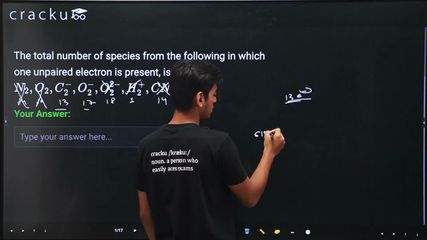
The total number of species from the following in which one unpaired electron is present, is _______
$$N_2, O_2, C_2^-, O_2^-, O_2^{2-}, H_2^+, CN^-, He_2^+$$
Correct Answer: 4
We need to find the total number of species from the given list that have exactly one unpaired electron. We use Molecular Orbital Theory (MOT) to determine the electronic configurations.
Recall: The molecular orbital filling order for diatomic molecules is:
For $$Z \leq 7$$ (like N, C): $$\sigma_{1s}, \sigma^*_{1s}, \sigma_{2s}, \sigma^*_{2s}, \pi_{2p_x} = \pi_{2p_y}, \sigma_{2p_z}, \pi^*_{2p_x} = \pi^*_{2p_y}, \sigma^*_{2p_z}$$
For $$Z > 7$$ (like O): $$\sigma_{1s}, \sigma^*_{1s}, \sigma_{2s}, \sigma^*_{2s}, \sigma_{2p_z}, \pi_{2p_x} = \pi_{2p_y}, \pi^*_{2p_x} = \pi^*_{2p_y}, \sigma^*_{2p_z}$$
1. $$N_2$$ (14 electrons):
Configuration: $$(\sigma_{1s})^2 (\sigma^*_{1s})^2 (\sigma_{2s})^2 (\sigma^*_{2s})^2 (\pi_{2p})^4 (\sigma_{2p_z})^2$$
All electrons are paired. Unpaired electrons = 0. Not selected.
2. $$O_2$$ (16 electrons):
Configuration: ...$$(\sigma_{2p_z})^2 (\pi_{2p})^4 (\pi^*_{2p})^2$$
The two electrons in $$\pi^*_{2p}$$ occupy one each of $$\pi^*_{2p_x}$$ and $$\pi^*_{2p_y}$$ by Hund's rule. Unpaired electrons = 2. Not selected.
3. $$C_2^-$$ (13 electrons):
$$C_2$$ has 12 electrons; adding 1 gives 13. Configuration: $$(\sigma_{1s})^2 (\sigma^*_{1s})^2 (\sigma_{2s})^2 (\sigma^*_{2s})^2 (\pi_{2p})^4 (\sigma_{2p_z})^1$$
Unpaired electrons = 1. Selected.
4. $$O_2^-$$ (17 electrons):
$$O_2$$ has 16 electrons; adding 1 gives 17. Configuration: ...$$(\pi^*_{2p})^3$$
Three electrons in two degenerate $$\pi^*$$ orbitals: 2 in one, 1 in the other. Unpaired electrons = 1. Selected.
5. $$O_2^{2-}$$ (18 electrons):
$$O_2$$ has 16 electrons; adding 2 gives 18. Configuration: ...$$(\pi^*_{2p})^4$$
Both $$\pi^*$$ orbitals are fully filled. Unpaired electrons = 0. Not selected.
6. $$H_2^+$$ (1 electron):
Configuration: $$(\sigma_{1s})^1$$
One electron in the bonding orbital. Unpaired electrons = 1. Selected.
7. $$CN^-$$ (14 electrons):
C has 6 electrons, N has 7, plus 1 for the negative charge = 14 electrons. This is isoelectronic with $$N_2$$.
Configuration is the same as $$N_2$$: all electrons paired. Unpaired electrons = 0. Not selected.
8. $$He_2^+$$ (3 electrons):
Two He atoms contribute 4 electrons; removing 1 gives 3. Configuration: $$(\sigma_{1s})^2 (\sigma^*_{1s})^1$$
Unpaired electrons = 1. Selected.
Summary: Species with exactly 1 unpaired electron: $$C_2^-$$, $$O_2^-$$, $$H_2^+$$, $$He_2^+$$.
The total count is $$\boxed{4}$$.
Was this solution helpful?
Click on the Email ☝️ to Watch the Video Solution
Create a FREE account and get:
Educational materials for JEE preparation

Ask our AI anything

AI can make mistakes. Please verify important information.
AI can make mistakes. Please verify important information.

_1.webp)
