
Join Our JEE Preparation Group
Prep with like-minded aspirants; Get access to free daily tests and study material.
Sign in
Please select an account to continue using cracku.in
↓ →
Join Our JEE Preparation Group
Prep with like-minded aspirants; Get access to free daily tests and study material.
The number of bridging CO ligand(s) and Co-Co bond(s) in $$Co_2(CO)_8$$, respectively are:
We begin by recalling that $$Co_2(CO)_8$$ is a dinuclear metal carbonyl of cobalt in the zero-oxidation state. Such compounds normally try to let every metal centre attain the very stable $$18$$-electron configuration.
First let us calculate the valence-electron requirement for one cobalt atom. In the elemental state cobalt is $$[Ar]\,3d^7 4s^2$$, so a neutral $$Co(0)$$ contributes $$9$$ valence electrons. To reach $$18$$ electrons it therefore still needs $$18-9 = 9$$ electrons supplied through coordination.
Now consider the carbonyl ligands. A terminal $$CO$$ donates a pair (that is, $$2$$) of electrons to the metal centre, whereas a $$\mu\text{-}CO$$ (bridging CO) donates only one electron to each of the two metals it bridges, because the same electron pair is shared between the two metal atoms.
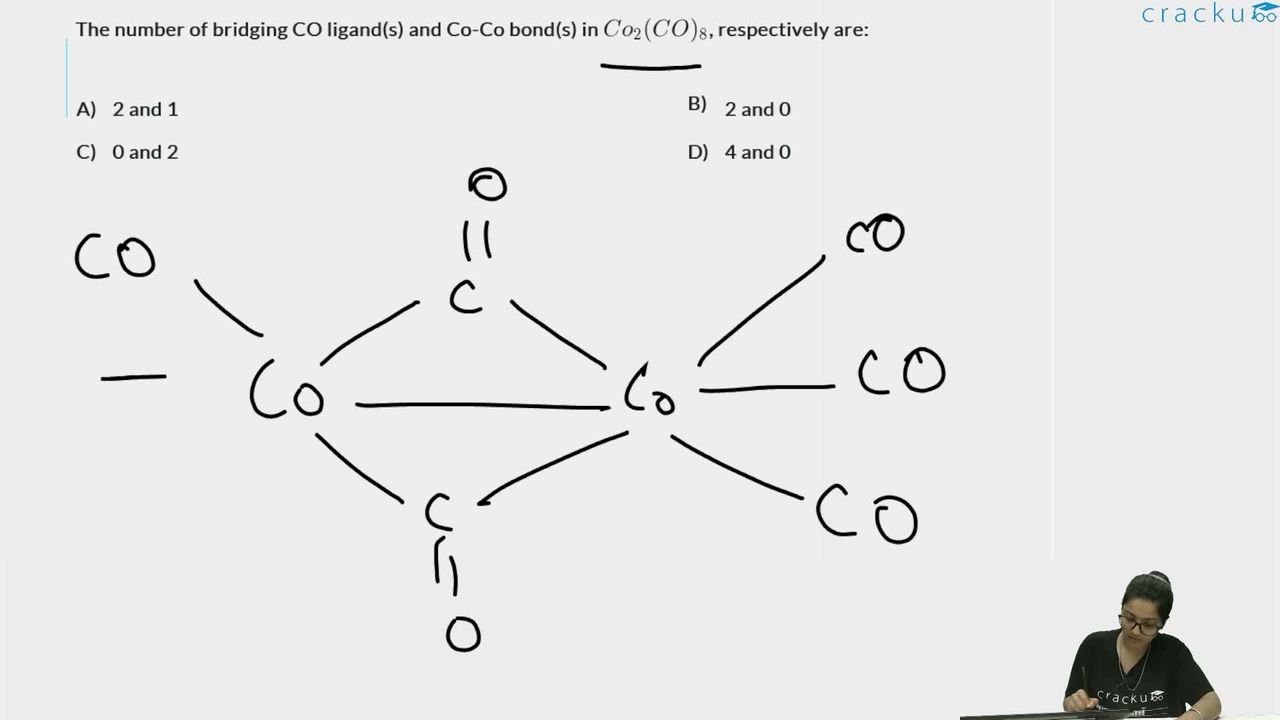
The solid-state structure of $$Co_2(CO)_8$$ determined by X-ray diffraction shows exactly two $$\mu\text{-}CO$$ ligands. The remaining six carbonyls are terminal. We therefore distribute the ligands as follows:
• On each cobalt there are three terminal $$CO$$ groups.
• Both cobalts together share the two bridging $$CO$$ groups (each bridge counts once for each Co).
Let us now perform the electron count for one cobalt atom.
From the metal itself: $$9$$ electrons.
From the three terminal $$CO$$ ligands: each gives $$2$$ electrons, so $$3 \times 2 = 6$$ electrons.
From the two bridging $$CO$$ ligands: each gives $$1$$ electron, so $$2 \times 1 = 2$$ electrons.
So far the cobalt has $$9 + 6 + 2 = 17$$ electrons; it is still one electron short of the desired $$18$$.
To supply this last electron, a direct metal-metal bond is formed between the two cobalt atoms. In a single $$Co{-}Co$$ bond the two metals share a pair of electrons, each metal effectively receiving one additional electron.
After adding this contribution the electron count becomes $$17 + 1 = 18$$, satisfying the $$18$$-electron rule for each cobalt centre. The need to reach this count is exactly what forces the existence of a single $$Co{-}Co$$ bond in the molecule.
Summarising the structural features we have just derived:
• Number of bridging $$CO$$ ligands $$(\mu\text{-}CO) = 2.$$
• Number of $$Co{-}Co$$ bonds = 1.
Turning to the options given in the problem, the pair “2 and 1” appears as Option A.
Hence, the correct answer is Option A.
Was this solution helpful?
Click on the Email ☝️ to Watch the Video Solution
Create a FREE account and get:
_1.webp)

Educational materials for JEE preparation

Ask our AI anything

AI can make mistakes. Please verify important information.
AI can make mistakes. Please verify important information.


