
Join Our JEE Preparation Group
Prep with like-minded aspirants; Get access to free daily tests and study material.
Sign in
Please select an account to continue using cracku.in
↓ →
Join Our JEE Preparation Group
Prep with like-minded aspirants; Get access to free daily tests and study material.
The first and second ionization constants of a weak dibasic acid $$H_2A$$ are $$8.1 \times 10^{-8}$$ and $$1.0 \times 10^{-13}$$ respectively. 0.1 mol of $$H_2A$$ was dissolved in 1 L of 0.1 M HCl solution. The concentration of $$HA^-$$ in the resultant solution is :
Step 1:
The two successive ionisation steps of the dibasic acid are
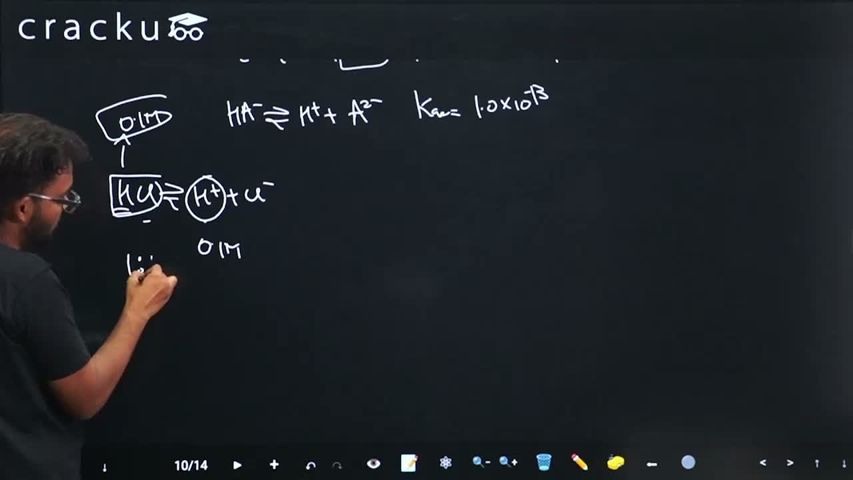
$$H_2A \;\rightleftharpoons\; H^+ + HA^- \qquad\qquad K_{a1}=8.1\times10^{-8}$$
$$HA^- \;\rightleftharpoons\; H^+ + A^{2-} \qquad\qquad K_{a2}=1.0\times10^{-13}$$
A solution is prepared by dissolving $$0.1\,$$mol of $$H_2A$$ in $$1\,$$L of $$0.1\,$$M $$HCl$$.
Hence,
$$[\!H^+\!]_{\text{from HCl}} = 0.1\ \text{M},\qquad [\!H_2A]_{\text{initial}} = 0.1\ \text{M}$$
Step 2:
The strong acid ($$HCl$$) fixes the hydrogen-ion concentration at about $$0.1\,$$M.
Because this value is much larger than the acid’s own $$K_{a1}$$, the dissociation of $$H_2A$$ will be greatly suppressed.
Let, $$x = [HA^-]$$ formed at equilibrium from the first dissociation.
Step 3:
Then
$$[H^+] \approx 0.1 + x \approx 0.1\ \text{M}\quad(\text{since }x\ll0.1)$$
$$[H_2A] \approx 0.1 - x \approx 0.1\ \text{M}$$
Apply the first-step ionisation constant:
$$K_{a1} = \frac{[H^+][HA^-]}{[H_2A]}$$
Substituting the approximate concentrations:
$$8.1\times10^{-8} = \frac{(0.1)\,x}{0.1} = x$$
Thus
$$[HA^-] = 8.1 \times 10^{-8}\ \text{M}$$
The second ionisation (governed by $$K_{a2}=1.0\times10^{-13}$$) is even more strongly suppressed in such an acidic medium, so its contribution to $$[HA^-]$$ is negligible.
Therefore, the concentration of $$HA^-$$ in the solution is $$8.1 \times 10^{-8}\,$$M.
Option C $$\longrightarrow\ $$ $$8.1 \times 10^{-8}\ \text{M}$$
Was this solution helpful?
Click on the Email ☝️ to Watch the Video Solution
Create a FREE account and get:
_1.webp)

Educational materials for JEE preparation

Ask our AI anything

AI can make mistakes. Please verify important information.
AI can make mistakes. Please verify important information.
