
Join Our JEE Preparation Group
Prep with like-minded aspirants; Get access to free daily tests and study material.
Sign in
Please select an account to continue using cracku.in
↓ →
Join Our JEE Preparation Group
Prep with like-minded aspirants; Get access to free daily tests and study material.
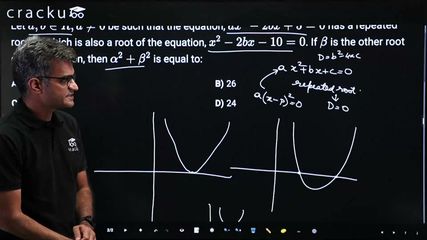
Let $$a, b \in R, a \ne 0$$ be such that the equation, $$ax^2 - 2bx + 5 = 0$$ has a repeated root $$\alpha$$, which is also a root of the equation, $$x^2 - 2bx - 10 = 0$$. If $$\beta$$ is the other root of this equation, then $$\alpha^2 + \beta^2$$ is equal to:
We are given two real numbers $$a,\,b$$ with $$a\neq 0$$ such that the quadratic equation $$ax^{2}-2bx+5=0$$ possesses a repeated (double) root $$\alpha$$. For a quadratic $$Ax^{2}+Bx+C=0$$ to have a repeated root, its discriminant must vanish. The discriminant formula is $$\Delta=B^{2}-4AC$$, so we write
$$\Delta = (-2b)^{2}-4\,(a)\,(5)=0.$$
Evaluating each term, we get
$$4b^{2}-20a=0 \;\Longrightarrow\; b^{2}-5a = 0 \;\Longrightarrow\; b^{2}=5a. \quad -(1)$$
The value of the repeated root of a quadratic $$Ax^{2}+Bx+C=0$$ is $$-\dfrac{B}{2A}$$. In our first equation the coefficients are $$A=a,\;B=-2b$$, hence
$$\alpha = -\dfrac{-2b}{2a}=\dfrac{2b}{2a}=\dfrac{b}{a}. \quad -(2)$$
This same number $$\alpha$$ is also a root of the second quadratic equation
$$x^{2}-2bx-10=0.$$
Therefore $$\alpha$$ satisfies
$$\alpha^{2}-2b\alpha-10=0. \quad -(3)$$
Substituting $$\alpha=\dfrac{b}{a}$$ from (2) into (3) gives
$$\left(\dfrac{b}{a}\right)^{2}-2b\left(\dfrac{b}{a}\right)-10=0.$$
Simplify each term:
$$\dfrac{b^{2}}{a^{2}}-\dfrac{2b^{2}}{a}-10=0.$$
To clear denominators we multiply every term by $$a^{2}$$:
$$b^{2}-2b^{2}a-10a^{2}=0. \quad -(4)$$
We now use the earlier relation (1): $$b^{2}=5a$$. Substituting this into (4) gives
$$5a-2(5a)a-10a^{2}=0 \;\Longrightarrow\; 5a-10a^{2}-10a^{2}=0.$$
Combining like terms,
$$5a-20a^{2}=0 \;\Longrightarrow\; 5a\,(1-4a)=0.$$
Because $$a\neq 0$$, we must have
$$1-4a=0 \;\Longrightarrow\; a=\dfrac14. \quad -(5)$$
Using (1) again, we find
$$b^{2}=5a=5\!\left(\dfrac14\right)=\dfrac54.$$
Hence $$b=\pm\dfrac{\sqrt5}{2}.$$ (Either sign will yield the same final value we seek.) Now, from (2),
$$\alpha=\dfrac{b}{a}=b\div\dfrac14=4b,$$
so
$$\alpha^{2}=(4b)^{2}=16b^{2}=16\left(\dfrac54\right)=20. \quad -(6)$$
Let $$\beta$$ be the other root of the second equation $$x^{2}-2bx-10=0$$. For a quadratic $$x^{2}+px+q=0$$, the sum and product of roots are $$-p$$ and $$q$$ respectively. Here the coefficient of $$x$$ is $$-2b$$ and the constant term is $$-10$$, so
$$\alpha+\beta=2b,\qquad \alpha\beta=-10. \quad -(7)$$
We want $$\alpha^{2}+\beta^{2}$$. We use the algebraic identity
$$\alpha^{2}+\beta^{2}=(\alpha+\beta)^{2}-2\alpha\beta. \quad -(8)$$
Substituting from (7) into (8),
$$\alpha^{2}+\beta^{2}=(2b)^{2}-2(-10)=4b^{2}+20.$$
But $$b^{2}=\dfrac54$$, so
$$4b^{2}+20=4\left(\dfrac54\right)+20=5+20=25. \quad -(9)$$
Thus,
$$\alpha^{2}+\beta^{2}=25.$$
Hence, the correct answer is Option A.
Was this solution helpful?
Click on the Email ☝️ to Watch the Video Solution
Create a FREE account and get:
_1.webp)

Educational materials for JEE preparation

Ask our AI anything

AI can make mistakes. Please verify important information.
AI can make mistakes. Please verify important information.
