
Join Our JEE Preparation Group
Prep with like-minded aspirants; Get access to free daily tests and study material.
Sign in
Please select an account to continue using cracku.in
↓ →
Join Our JEE Preparation Group
Prep with like-minded aspirants; Get access to free daily tests and study material.
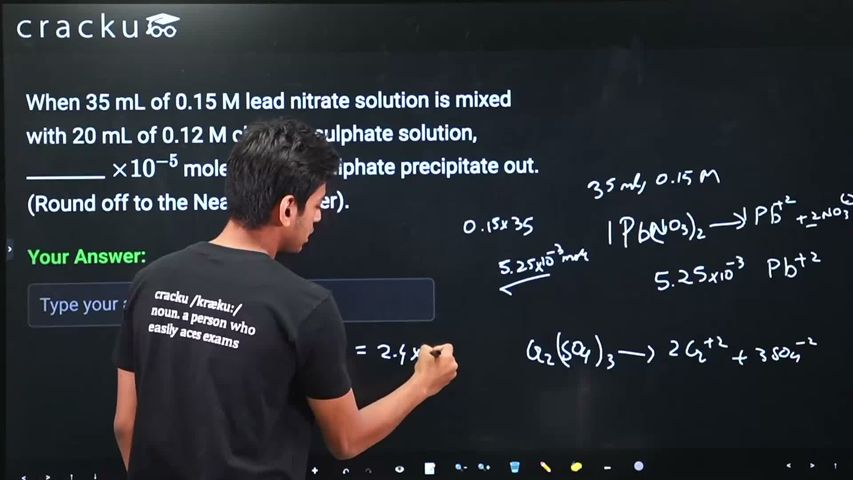
When 35 mL of 0.15 M lead nitrate solution is mixed with 20 mL of 0.12 M chromic sulphate solution, ________ $$\times 10^{-5}$$ moles of lead sulphate precipitate out. (Round off to the Nearest Integer).
Correct Answer: 525
We are given 35 mL of 0.15 M lead nitrate ($$Pb(NO_3)_2$$) and 20 mL of 0.12 M chromic sulphate ($$Cr_2(SO_4)_3$$). The precipitation reaction is: $$Pb^{2+} + SO_4^{2-} \rightarrow PbSO_4 \downarrow$$.
Moles of $$Pb^{2+}$$ ions = $$0.035 \times 0.15 = 0.00525$$ mol.
Since each formula unit of $$Cr_2(SO_4)_3$$ provides 3 sulphate ions, the moles of $$SO_4^{2-}$$ ions = $$0.020 \times 0.12 \times 3 = 0.0072$$ mol.
The reaction between $$Pb^{2+}$$ and $$SO_4^{2-}$$ is in a 1:1 molar ratio. Since 0.00525 mol of $$Pb^{2+}$$ is less than 0.0072 mol of $$SO_4^{2-}$$, lead is the limiting reagent.
Therefore, moles of $$PbSO_4$$ precipitated = $$0.00525$$ mol = $$525 \times 10^{-5}$$ mol.
The answer is $$525$$.
Was this solution helpful?
Click on the Email ☝️ to Watch the Video Solution
Create a FREE account and get:
_1.webp)

Educational materials for JEE preparation

Ask our AI anything

AI can make mistakes. Please verify important information.
AI can make mistakes. Please verify important information.
