
Join Our JEE Preparation Group
Prep with like-minded aspirants; Get access to free daily tests and study material.
Sign in
Please select an account to continue using cracku.in
↓ →
Join Our JEE Preparation Group
Prep with like-minded aspirants; Get access to free daily tests and study material.
The product of the roots of the equation $$9x^2 - 18|x| + 5 = 0$$ is:
We start with the given quadratic expression that involves the modulus function:
$$9x^2-18|x|+5=0.$$
The absolute value $$|x|$$ creates two separate algebraic cases, because by definition
$$ |x|= \begin{cases} x & \text{when } x\ge 0,\\[4pt] -x & \text{when } x<0. \end{cases} $$
We therefore analyse each case separately and afterwards retain only those roots that satisfy the sign condition assumed while forming that case.
Case 1 : We assume $$x\ge 0,$$ so $$|x|=x.$$ Substituting this in the original equation gives
$$9x^2-18x+5=0.$$
To solve any quadratic of the form $$ax^2+bx+c=0,$$ we use the quadratic-formula
$$x=\dfrac{-b\pm\sqrt{\,b^2-4ac\,}}{2a}.$$
Here, $$a=9,\; b=-18,\; c=5.$$ The discriminant is computed first:
$$\Delta=b^2-4ac=(-18)^2-4(9)(5)=324-180=144.$$
Its square-root is $$\sqrt{144}=12.$$ Substituting in the formula:
$$ x=\dfrac{-(-18)\pm 12}{2\cdot 9} =\dfrac{18\pm 12}{18}. $$
This gives two roots
$$x_1=\dfrac{18+12}{18}=\dfrac{30}{18}=\dfrac{5}{3},\qquad x_2=\dfrac{18-12}{18}=\dfrac{6}{18}=\dfrac{1}{3}.$$
Both numbers are non-negative, so both belong to the present case and are valid.
Case 2 : We assume $$x<0,$$ so $$|x|=-x.$$ Substituting this into the original equation yields
$$9x^2-18(-x)+5=9x^2+18x+5=0.$$
Again we identify $$a=9,\; b=18,\; c=5$$ and apply the quadratic formula. First the discriminant:
$$\Delta=b^2-4ac=18^2-4(9)(5)=324-180=144,$$
and again $$\sqrt{\Delta}=12.$$ Thus
$$ x=\dfrac{-18\pm 12}{2\cdot 9} =\dfrac{-18\pm 12}{18}. $$
This furnishes
$$x_3=\dfrac{-18+12}{18}=\dfrac{-6}{18}=-\dfrac{1}{3},\qquad x_4=\dfrac{-18-12}{18}=\dfrac{-30}{18}=-\dfrac{5}{3}.$$
Both are negative, matching the assumption $$x<0,$$ hence both are admissible.
Collecting the four valid roots, we have
$$x_1=\dfrac{5}{3},\; x_2=\dfrac{1}{3},\; x_3=-\dfrac{1}{3},\; x_4=-\dfrac{5}{3}.$$
The product of all roots is
$$ x_1x_2x_3x_4 =\left(\dfrac{5}{3}\right)\!\left(\dfrac{1}{3}\right)\! \left(-\dfrac{1}{3}\right)\!\left(-\dfrac{5}{3}\right). $$
First multiply the two negative factors:
$$\left(-\dfrac{1}{3}\right)\!\left(-\dfrac{5}{3}\right)=\dfrac{5}{9}.$$
Next multiply the two positive factors:
$$\left(\dfrac{5}{3}\right)\!\left(\dfrac{1}{3}\right)=\dfrac{5}{9}.$$
Finally multiply these intermediate results:
$$\dfrac{5}{9}\times\dfrac{5}{9}=\dfrac{25}{81}.$$
Hence, the correct answer is Option B.
Was this solution helpful?
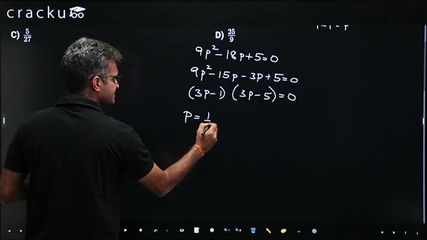
Click on the Email ☝️ to Watch the Video Solution
Create a FREE account and get:
_1.webp)

Educational materials for JEE preparation

Ask our AI anything

AI can make mistakes. Please verify important information.
AI can make mistakes. Please verify important information.


