
Join Our JEE Preparation Group
Prep with like-minded aspirants; Get access to free daily tests and study material.
Sign in
Please select an account to continue using cracku.in
↓ →
Join Our JEE Preparation Group
Prep with like-minded aspirants; Get access to free daily tests and study material.
Consider the two sets:
$$A = \{m \in R : \text{both the roots of } x^2 - (m+1)x + m + 4 = 0 \text{ are real}\}$$ and $$B = [-3, 5)$$
Which of the following is not true?
We are given the quadratic equation $$x^{2}-(m+1)x+m+4=0$$ and we must find all real numbers $$m$$ for which both its roots are real.
For any quadratic equation $$ax^{2}+bx+c=0,$$ the condition for real roots is that its discriminant is non-negative.
So we state the formula: $$\text{If } ax^{2}+bx+c=0,\; \text{then real roots} \Longleftrightarrow b^{2}-4ac\ge 0.$$
Here, by comparison, we have $$a=1,\; b=-(m+1),\; c=m+4.$$
Now we compute the discriminant:
$$\begin{aligned} D &= b^{2}-4ac \\ &= (-(m+1))^{2}-4(1)(m+4) \\ &= (m+1)^{2}-4m-16. \end{aligned}$$
Next, we expand $$(m+1)^{2}:$$
$$\begin{aligned} (m+1)^{2} &= m^{2}+2m+1, \\ \therefore D &= (m^{2}+2m+1)-4m-16 \\ &= m^{2}+2m+1-4m-16 \\ &= m^{2}-2m-15. \end{aligned}$$
For real roots we require $$D\ge 0,$$ so
$$m^{2}-2m-15\ge 0.$$
We factor the left side completely:
$$m^{2}-2m-15=(m-5)(m+3).$$
Thus,
$$ (m-5)(m+3)\ge 0. $$
For a product of two linear factors, the inequality $$PQ\ge 0$$ holds when both factors are non-negative or both are non-positive. Analysis of the critical points $$m=-3$$ and $$m=5$$ gives:
$$m\le -3 \quad \text{or} \quad m\ge 5.$$
Therefore
$$A = (-\infty,\,-3]\;\cup\;[5,\infty).$$
We are also given
$$B=[-3,\,5).$$
Now we examine each option one by one.
Option A: $$A-B = (-\infty,-3)\cup(5,\infty)$$
We calculate $$A-B$$ carefully.
Thus
$$A-B = (-\infty,-3)\;\cup\;[5,\infty).$$
But Option A omits the point $$5,$$ writing $$(5,\infty)$$ instead of $$[5,\infty).$$ Hence Option A is not true.
Option B: $$A\cap B=\{-3\}$$
The intersection of $$(-\infty,-3]$$ with $$[-3,5)$$ gives just the single point $$-3,$$ and $$[5,\infty)$$ has empty overlap with $$[-3,5).$$ Hence Option B is true.
Option C: $$B-A=(-3,5)$$
Inside $$B$$ the point $$-3$$ is removed because $$-3\in A,$$ and $$5$$ is not in $$B$$ at all, so what remains is the open interval $$(-3,5).$$ Thus Option C is true.
Option D: $$A\cup B=\mathbb{R}$$
The union $$(-\infty,-3]\cup[-3,5)\cup[5,\infty)$$ clearly covers every real number, so Option D is also true.
We see that the only statement that fails is Option A.
Hence, the correct answer is Option A.
Was this solution helpful?
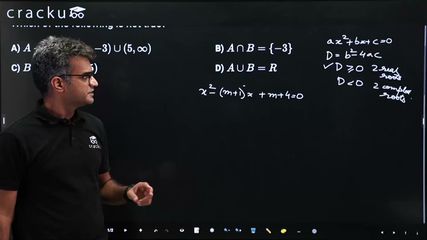
Click on the Email ☝️ to Watch the Video Solution
Create a FREE account and get:
_1.webp)

Educational materials for JEE preparation

Ask our AI anything

AI can make mistakes. Please verify important information.
AI can make mistakes. Please verify important information.
