
Join Our JEE Preparation Group
Prep with like-minded aspirants; Get access to free daily tests and study material.
Sign in
Please select an account to continue using cracku.in
↓ →
Join Our JEE Preparation Group
Prep with like-minded aspirants; Get access to free daily tests and study material.
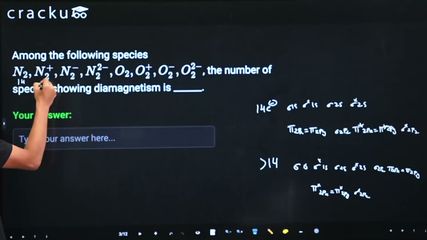
Among the following species $$N_2, N_2^+, N_2^-, N_2^{2-}, O_2, O_2^+, O_2^-, O_2^{2-}$$, the number of species showing diamagnetism is ______.
Correct Answer: 2
We need to count the number of diamagnetic species among: $$N_2, N_2^+, N_2^-, N_2^{2-}, O_2, O_2^+, O_2^-, O_2^{2-}$$.
A species is considered diamagnetic if all electrons are paired (no unpaired electrons).
Considering first the nitrogen species, we use the MO order $$\sigma_{1s}, \sigma^*_{1s}, \sigma_{2s}, \sigma^*_{2s}, \pi_{2p_x} = \pi_{2p_y}, \sigma_{2p_z}, \pi^*_{2p_x} = \pi^*_{2p_y}, \sigma^*_{2p_z}$$. In $$N_2$$ with 14 electrons the configuration is $$...\sigma_{2s}^2, {\sigma^*_{2s}}^{2}, \pi_{2p_x}^2 = \pi_{2p_y}^2, \sigma_{2p_z}^2$$, so all electrons are paired and the molecule is diamagnetic.
In $$N_2^+$$ there are 13 electrons, corresponding to the removal of one electron from $$\sigma_{2p_z}$$, which leaves one unpaired electron and therefore makes it paramagnetic.
Adding an electron to $$N_2$$ gives $$N_2^-$$ with 15 electrons, where the extra electron occupies a $$\pi^*_{2p}$$ orbital, resulting in one unpaired electron and paramagnetism.
In $$N_2^{2-}$$ the two additional electrons occupy $${\pi^*_{2p_x}}^{1}$$ and $${\pi^*_{2p_y}}^{1}$$, producing two unpaired electrons and a paramagnetic species.
Turning to the oxygen species, we adopt the MO order $$\sigma_{2s}, \sigma^*_{2s}, \sigma_{2p_z}, \pi_{2p_x} = \pi_{2p_y}, \pi^*_{2p_x} = \pi^*_{2p_y}, \sigma^*_{2p_z}$$. For $$O_2$$ with 16 electrons the configuration is $$...\sigma_{2p_z}^2, \pi_{2p_x}^2 = \pi_{2p_y}^2, {\pi^*_{2p_x}}^{1} = {\pi^*_{2p_y}}^{1}$$, which has two unpaired electrons and is therefore paramagnetic.
Removing one electron from $$O_2$$ yields $$O_2^+$$ with 15 electrons, leaving one electron in a $$\pi^*$$ orbital and one unpaired electron; this species is paramagnetic.
In $$O_2^-$$ the 17th electron enters $$\pi^*_{2p_x}$$, resulting in the configuration $${\pi^*_{2p_x}}^{2}, {\pi^*_{2p_y}}^{1}$$ and one unpaired electron, so it is paramagnetic.
The peroxide ion $$O_2^{2-}$$ has 18 electrons filling both $$\pi^*_{2p_x}$$ and $$\pi^*_{2p_y}$$ orbitals with paired electrons, making it diamagnetic.
Among the eight species considered, only $$N_2$$ and $$O_2^{2-}$$ have all electrons paired, giving two diamagnetic species.
Hence, the answer is 2.
Was this solution helpful?
Click on the Email ☝️ to Watch the Video Solution
Create a FREE account and get:
Educational materials for JEE preparation

Ask our AI anything

AI can make mistakes. Please verify important information.
AI can make mistakes. Please verify important information.

_1.webp)
