
Join Our JEE Preparation Group
Prep with like-minded aspirants; Get access to free daily tests and study material.
Sign in
Please select an account to continue using cracku.in
↓ →
Join Our JEE Preparation Group
Prep with like-minded aspirants; Get access to free daily tests and study material.
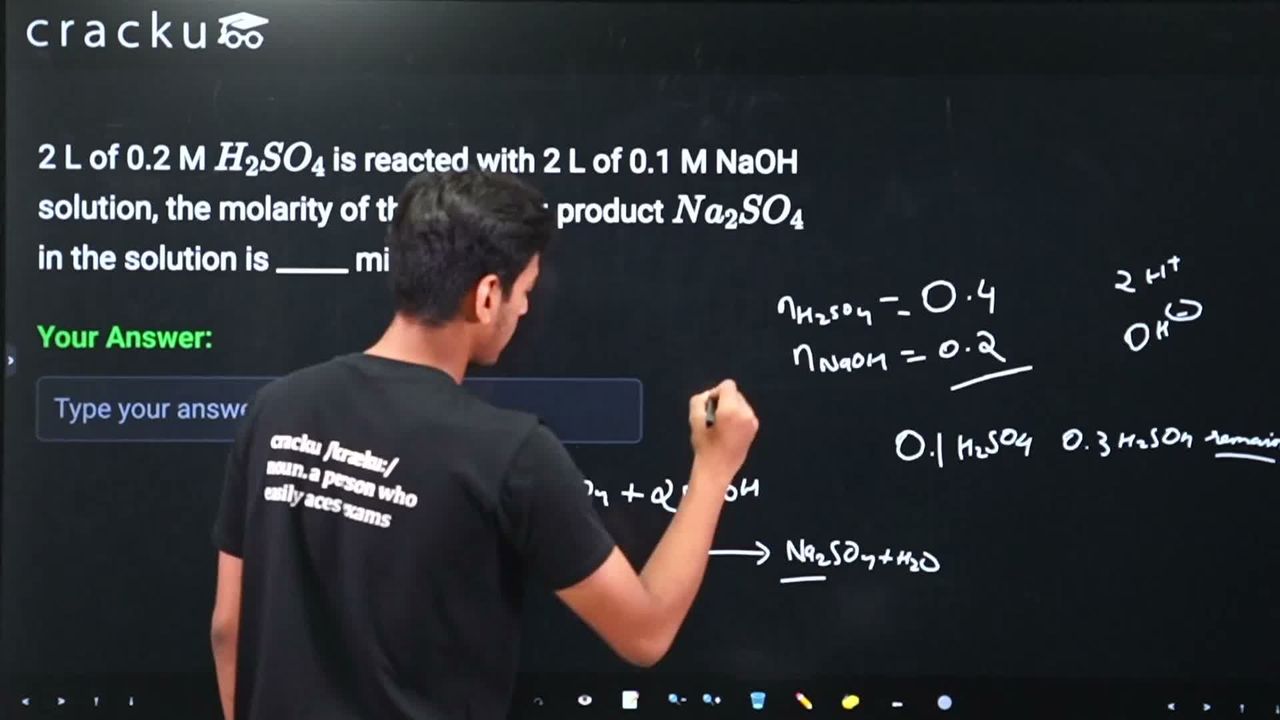
2 L of 0.2 M $$H_2SO_4$$ is reacted with 2 L of 0.1 M NaOH solution, the molarity of the resulting product $$Na_2SO_4$$ in the solution is _____ millimolar.
Correct Answer: 25
We have 2 L of 0.2 M $$H_2SO_4$$ and 2 L of 0.1 M NaOH solution being mixed together. We need to find the molarity of $$Na_2SO_4$$ formed in the resulting solution.
First, let us calculate the moles of each reactant.
Moles of $$H_2SO_4 = 0.2 \times 2 = 0.4$$ mol
Moles of NaOH $$= 0.1 \times 2 = 0.2$$ mol
The reaction between $$H_2SO_4$$ and NaOH is:
$$H_2SO_4 + 2NaOH \rightarrow Na_2SO_4 + 2H_2O$$
From the stoichiometry, 1 mol of $$H_2SO_4$$ requires 2 mol of NaOH. So 0.2 mol of NaOH would react with $$\frac{0.2}{2} = 0.1$$ mol of $$H_2SO_4$$.
Since we have 0.4 mol of $$H_2SO_4$$ but only 0.2 mol of NaOH, the NaOH is the limiting reagent. All 0.2 mol of NaOH reacts with 0.1 mol of $$H_2SO_4$$, and the remaining 0.3 mol of $$H_2SO_4$$ stays unreacted.
From the stoichiometry, 0.1 mol of $$H_2SO_4$$ produces 0.1 mol of $$Na_2SO_4$$.
Now, the total volume of the resulting solution is $$2 + 2 = 4$$ L.
The molarity of $$Na_2SO_4$$ is:
$$\text{Molarity} = \frac{0.1}{4} = 0.025 \text{ M} = 25 \text{ millimolar}$$
Hence, the correct answer is 25.
Was this solution helpful?
Click on the Email ☝️ to Watch the Video Solution
Create a FREE account and get:
_1.webp)

Educational materials for JEE preparation

Ask our AI anything

AI can make mistakes. Please verify important information.
AI can make mistakes. Please verify important information.
