
Join Our JEE Preparation Group
Prep with like-minded aspirants; Get access to free daily tests and study material.
Sign in
Please select an account to continue using cracku.in
↓ →
Join Our JEE Preparation Group
Prep with like-minded aspirants; Get access to free daily tests and study material.
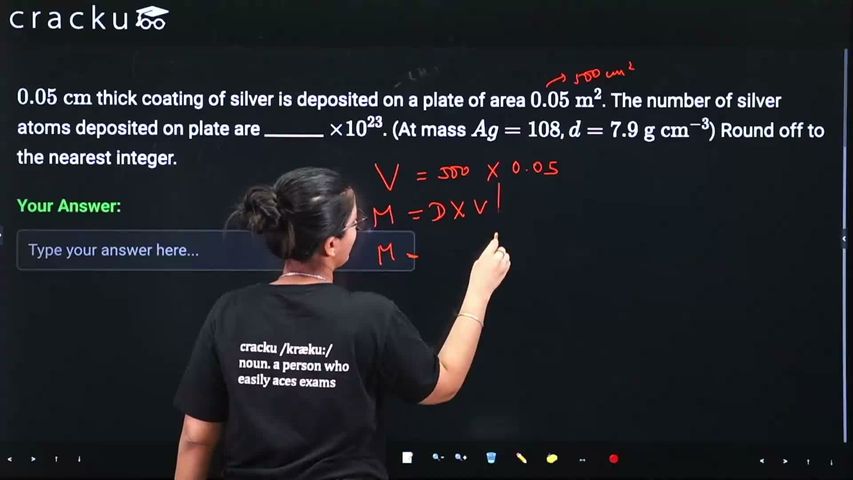
$$0.05 \text{ cm}$$ thick coating of silver is deposited on a plate of area $$0.05 \text{ m}^2$$. The number of silver atoms deposited on plate are _______ $$\times 10^{23}$$. (At mass $$Ag = 108$$, $$d = 7.9 \text{ g cm}^{-3}$$) Round off to the nearest integer.
Correct Answer: 11
We need to find the number of silver atoms deposited on a plate.
The thickness of the silver coating is $$0.05$$ cm, the area of the plate is $$0.05$$ m² which equals $$0.05 \times 10^4$$ cm² = $$500$$ cm², the atomic mass of Ag is $$108$$ g/mol, and the density of silver is $$d = 7.9$$ g/cm³.
The volume of the silver deposited is given by the product of the area and thickness: $$V = \text{Area} \times \text{Thickness} = 500 \times 0.05 = 25 \text{ cm}^3$$.
The mass of silver deposited follows from mass = density × volume: $$\text{mass} = \text{density} \times \text{volume}$$, thus $$m = 7.9 \times 25 = 197.5 \text{ g}$$.
The number of moles of silver is $$n = \frac{m}{M} = \frac{197.5}{108} = 1.8287 \text{ mol}$$.
The number of silver atoms is given by $$N = n \times N_A$$ where $$N_A = 6.022 \times 10^{23}$$, hence $$N = 1.8287 \times 6.022 \times 10^{23} = 11.013 \times 10^{23}$$.
Rounding to the nearest integer gives $$N \approx 11 \times 10^{23}$$.
Answer: 11
Was this solution helpful?
Click on the Email ☝️ to Watch the Video Solution
Create a FREE account and get:
_1.webp)

Educational materials for JEE preparation

Ask our AI anything

AI can make mistakes. Please verify important information.
AI can make mistakes. Please verify important information.
