
Join Our JEE Preparation Group
Prep with like-minded aspirants; Get access to free daily tests and study material.
Sign in
Please select an account to continue using cracku.in
↓ →
Join Our JEE Preparation Group
Prep with like-minded aspirants; Get access to free daily tests and study material.
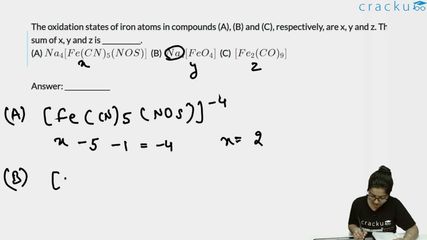
The oxidation states of iron atoms in compounds (A), (B) and (C), respectively, are x, y and z. Then sum of x, y and z is ___________.
(A) $$Na_4[Fe(CN)_5(NOS)]$$ (B) $$Na_4[FeO_4]$$ (C) $$[Fe_2(CO)_9]$$
Correct Answer: 6
We begin with compound (A) written as $$Na_4[Fe(CN)_5(NOS)]$$.
Each sodium ion carries a charge of $$+1$$, and there are four such ions, so their total positive charge is $$+4$$.
For the whole compound to be electrically neutral, the complex ion $$[Fe(CN)_5(NOS)]^{q-}$$ must therefore possess a charge of $$q=-4$$. Hence we write
$$[Fe(CN)_5(NOS)]^{4-}.$$
Now let the oxidation state of iron in (A) be $$x$$. The five $$CN$$ ligands are each cyanide ions $$CN^-$$ with charge $$-1$$, giving a total contribution of $$5(-1)=-5$$. The ligand $$NOS^-$$ (thionitrosyl) carries a single negative charge $$-1$$. Adding these together, the algebraic sum of charges inside the bracket becomes
$$x + (-5) + (-1) = -4.$$
Simplifying, we get
$$x - 6 = -4 \quad \Longrightarrow \quad x = +2.$$
So, in compound (A) the iron is in the $$+2$$ oxidation state.
Next we examine compound (B), $$Na_4[FeO_4]$$.
Again, four $$Na^+$$ ions contribute $$+4$$, so the anion $$[FeO_4]^{q-}$$ must have charge $$q=-4$$, i.e.
$$[FeO_4]^{4-}.$$
Let the oxidation state of iron here be $$y$$. Oxygen virtually always has the oxidation state $$-2$$. As there are four oxygens, their total contribution is $$4(-2)=-8$$. Therefore
$$y + (-8) = -4.$$
Rearranging,
$$y - 8 = -4 \quad \Longrightarrow \quad y = +4.$$
Thus, in compound (B) iron is in the $$+4$$ oxidation state.
Finally, we consider compound (C), $$[Fe_2(CO)_9]$$.
The carbonyl ligand $$CO$$ is neutral; its charge is $$0$$. The whole molecule is also neutral. Let the oxidation state of each iron atom be $$z$$. Because there are two iron atoms, the total contribution from iron is $$2z$$, while that from nine neutral carbonyls is $$9(0)=0$$. Therefore
$$2z + 0 = 0 \quad \Longrightarrow \quad z = 0.$$
So, in compound (C) each iron atom is in the $$0$$ oxidation state.
We now find the requested sum $$x + y + z$$:
$$x + y + z \;=\; (+2) + (+4) + 0 \;=\; 6.$$
So, the answer is $$6$$.
Click on the Email ☝️ to Watch the Video Solution
Create a FREE account and get:
_1.webp)

Educational materials for JEE preparation

Ask our AI anything

AI can make mistakes. Please verify important information.
AI can make mistakes. Please verify important information.


