
Join Our JEE Preparation Group
Prep with like-minded aspirants; Get access to free daily tests and study material.
Sign in
Please select an account to continue using cracku.in
↓ →
Join Our JEE Preparation Group
Prep with like-minded aspirants; Get access to free daily tests and study material.
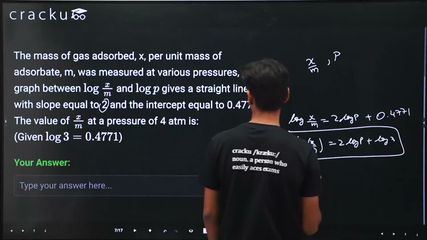
The mass of gas adsorbed, x, per unit mass of adsorbate, m, was measured at various pressures, p. A graph between $$\log \frac{x}{m}$$ and $$\log p$$ gives a straight line with slope equal to 2 and the intercept equal to 0.4771. The value of $$\frac{x}{m}$$ at a pressure of 4 atm is:
(Given $$\log 3 = 0.4771$$)
Correct Answer: 48
We start with the empirical Freundlich adsorption isotherm, which relates the amount of gas adsorbed per unit mass of adsorbent to the equilibrium pressure. Its mathematical statement is
$$\frac{x}{m}=k\,p^{1/n}.$$
Taking the common logarithm (base 10) of both sides, we obtain
$$\log\left(\frac{x}{m}\right)=\log k+\frac{1}{n}\,\log p.$$
In this linear form, the graph of $$\log\left(\dfrac{x}{m}\right)$$ (ordinate) versus $$\log p$$ (abscissa) is a straight line with
• slope $$\displaystyle\frac{1}{n},$$
• intercept on the ordinate (at $$\log p=0$$) equal to $$\log k.$$
According to the data in the question, the straight-line graph has
• slope $$=2,$$
• intercept $$=0.4771.$$
By comparing these two descriptions, we identify
$$\frac{1}{n}=2 \quad\Rightarrow\quad n=\frac{1}{2},$$
and
$$\log k=0.4771.$$
We are given in the problem statement that $$\log 3=0.4771.$$ Hence
$$k=3.$$
Now we need the value of $$\dfrac{x}{m}$$ at the pressure $$p=4\ \text{atm}.$$ Substituting $$p=4$$, $$k=3$$ and $$\dfrac{1}{n}=2$$ into the logarithmic form of the equation, we get
$$\log\left(\frac{x}{m}\right)=\log k + \frac{1}{n}\,\log p =0.4771+2\,\log 4.$$
Next we evaluate $$\log 4.$$ Noting that $$4=2^{2}$$ and that the common logarithm of 2 is approximately $$0.3010$$, we have
$$\log 4 = \log(2^{2}) = 2\log 2 = 2(0.3010)=0.6020.$$
Substituting this numerical value,
$$\log\left(\frac{x}{m}\right)=0.4771+2(0.6020) =0.4771+1.2040 =1.6811.$$
To find $$\dfrac{x}{m}$$ itself, we take the antilogarithm (i.e., raise 10 to both sides):
$$\frac{x}{m}=10^{1.6811}.$$
We separate the integer and fractional parts of the exponent:
$$10^{1.6811}=10^{1}\times10^{0.6811}=10 \times 4.80 \approx 48.$$
Thus the amount of gas adsorbed per unit mass of adsorbent at a pressure of 4 atm is approximately $$48$$ (in the same units as $$x/m$$ was measured).
Hence, the correct answer is Option D.
Click on the Email ☝️ to Watch the Video Solution
Create a FREE account and get:
_1.webp)

Educational materials for JEE preparation

Ask our AI anything

AI can make mistakes. Please verify important information.
AI can make mistakes. Please verify important information.


