
Join Our JEE Preparation Group
Prep with like-minded aspirants; Get access to free daily tests and study material.
Sign in
Please select an account to continue using cracku.in
↓ →
Join Our JEE Preparation Group
Prep with like-minded aspirants; Get access to free daily tests and study material.
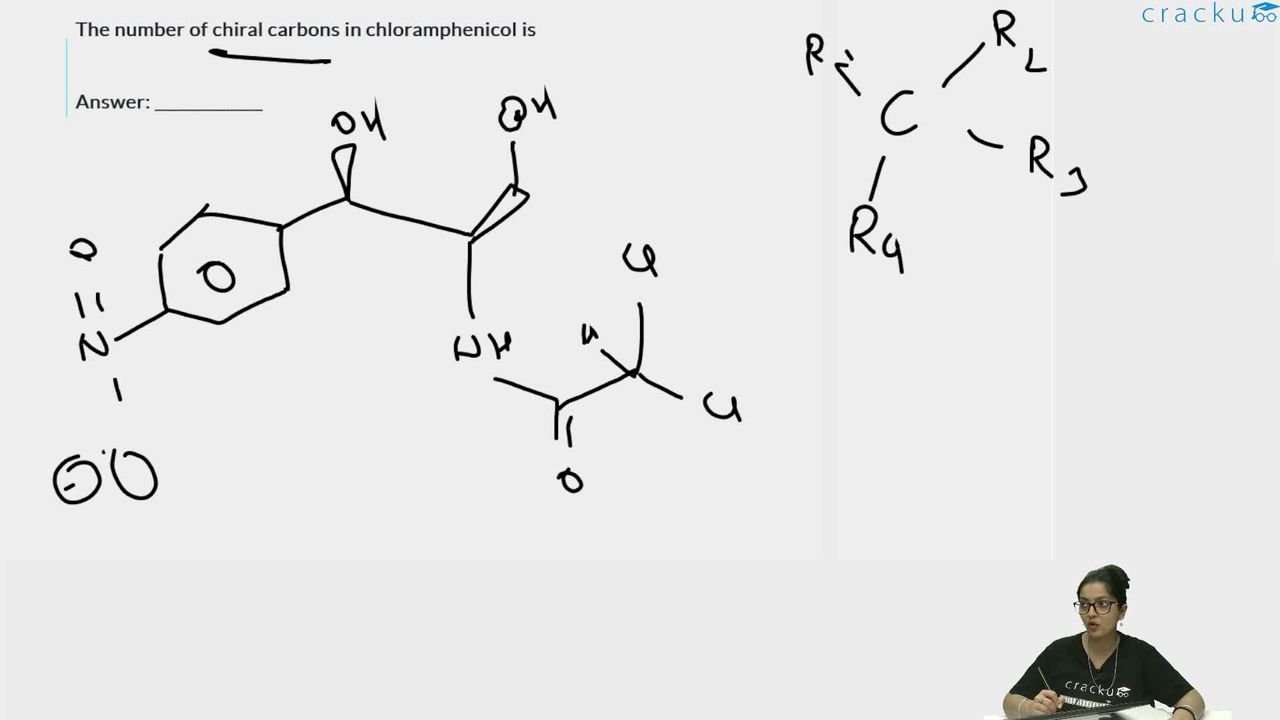
The number of chiral carbons in chloramphenicol is
Correct Answer: 2
Chloramphenicol is an antibiotic whose IUPAC name is 2,2-dichloro-$$N$$-[(1$$R$$,2$$R$$)-2-hydroxy-1-(hydroxymethyl)-2-(4-nitrophenyl)ethyl]acetamide.
Its structural formula is:
$$O_2N - C_6H_4 - CH(OH) - CH(NH - CO - CHCl_2) - CH_2OH$$
To find chiral carbons, we look for $$sp^3$$ hybridised carbon atoms bonded to four different groups.
Carbon 1: The carbon bearing the $$-OH$$ group, i.e. $$-CH(OH)-$$. Its four substituents are: (i) $$-C_6H_4(NO_2)$$ (the para-nitrophenyl ring), (ii) $$-OH$$, (iii) $$-H$$, (iv) the adjacent carbon bearing the amide group. All four groups are different, so this carbon is chiral.
Carbon 2: The carbon bearing the amide group, i.e. $$-CH(NHCO-CHCl_2)-$$. Its four substituents are: (i) $$-NHCO-CHCl_2$$, (ii) $$-CH_2OH$$, (iii) $$-H$$, (iv) the adjacent carbon bearing $$-OH$$. All four groups are different, so this carbon is also chiral.
Other carbons in the molecule are either part of the aromatic ring ($$sp^2$$), the carbonyl carbon ($$sp^2$$), the $$-CHCl_2$$ carbon (two identical Cl substituents, so not chiral), or the $$-CH_2OH$$ carbon (two identical H atoms, so not chiral).
Therefore, the number of chiral carbons in chloramphenicol is $$2$$.
The correct answer is $$2$$.
Was this solution helpful?
Click on the Email ☝️ to Watch the Video Solution
Create a FREE account and get:
_1.webp)

Educational materials for JEE preparation

Ask our AI anything

AI can make mistakes. Please verify important information.
AI can make mistakes. Please verify important information.


