
Join Our JEE Preparation Group
Prep with like-minded aspirants; Get access to free daily tests and study material.
Sign in
Please select an account to continue using cracku.in
↓ →
Join Our JEE Preparation Group
Prep with like-minded aspirants; Get access to free daily tests and study material.
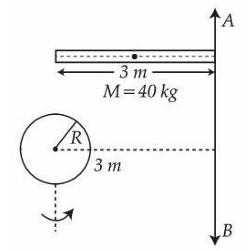
Moment of inertia about an axis $$AB$$ for a rod of mass 40 kg and length 3 m is same as that of a solid sphere of mass 10 kg and radius $$R$$ about an axis parallel to $$AB$$ axis with separation of 3 m as shown in figure. The value of $$R$$ is given as $$\sqrt{\frac{\alpha}{2}}$$. The value of $$\alpha$$ is _________.
Correct Answer: 15
For the rod (mass $$M = 40\ \text{kg}$$, length $$L = 3\ \text{m}$$) the axis $$AB$$ is perpendicular to the rod and passes through one of its ends.
Moment of inertia of a uniform rod about an axis perpendicular to the rod and through an end is
$$I_{\text{rod}} = \frac{1}{3} M L^{2}$$
Substituting the values:
$$I_{\text{rod}} = \frac{1}{3}\,(40)\,(3)^{2} = \frac{40 \times 9}{3} = 120\ \text{kg m}^{2}$$
For the solid sphere (mass $$m = 10\ \text{kg}$$, radius $$R$$) we need its moment of inertia about an axis parallel to its diameter but displaced by $$d = 3\ \text{m}$$ from the centre.
First write the moment of inertia about the central diameter:
$$I_{\text{cm}} = \frac{2}{5}\,m R^{2}$$
Apply the parallel-axis theorem, $$I = I_{\text{cm}} + m d^{2}$$, to shift the axis:
$$I_{\text{sphere}} = \frac{2}{5}\,m R^{2} + m d^{2}$$
Insert the numerical values $$m = 10\ \text{kg}$$ and $$d = 3\ \text{m}$$:
$$I_{\text{sphere}} = \frac{2}{5}\,(10) R^{2} + (10)(3)^{2} = 4 R^{2} + 90$$
The question states that the two moments of inertia are equal, so
$$I_{\text{rod}} = I_{\text{sphere}}$$
$$\Rightarrow 120 = 4 R^{2} + 90$$
Solve for $$R^{2}$$:
$$4 R^{2} = 120 - 90 = 30$$
$$\Rightarrow R^{2} = \frac{30}{4} = 7.5$$
The radius is expressed in the form $$R = \sqrt{\dfrac{\alpha}{2}}$$, so
$$R^{2} = \frac{\alpha}{2}$$
Compare with $$R^{2} = 7.5$$:
$$\frac{\alpha}{2} = 7.5 \quad\Longrightarrow\quad \alpha = 15$$
Hence the required value of $$\alpha$$ is 15.
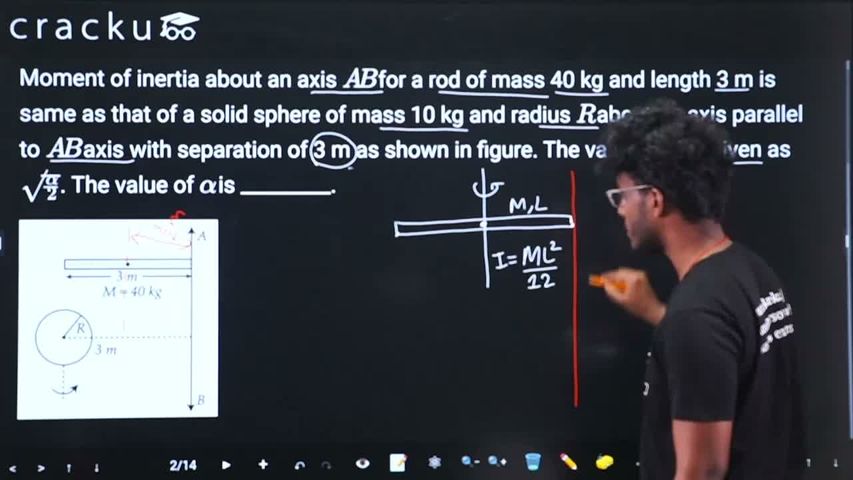
Click on the Email ☝️ to Watch the Video Solution
Create a FREE account and get:
_1.webp)

Educational materials for JEE preparation

Ask our AI anything

AI can make mistakes. Please verify important information.
AI can make mistakes. Please verify important information.


