
Join Our JEE Preparation Group
Prep with like-minded aspirants; Get access to free daily tests and study material.
Sign in
Please select an account to continue using cracku.in
↓ →
Join Our JEE Preparation Group
Prep with like-minded aspirants; Get access to free daily tests and study material.
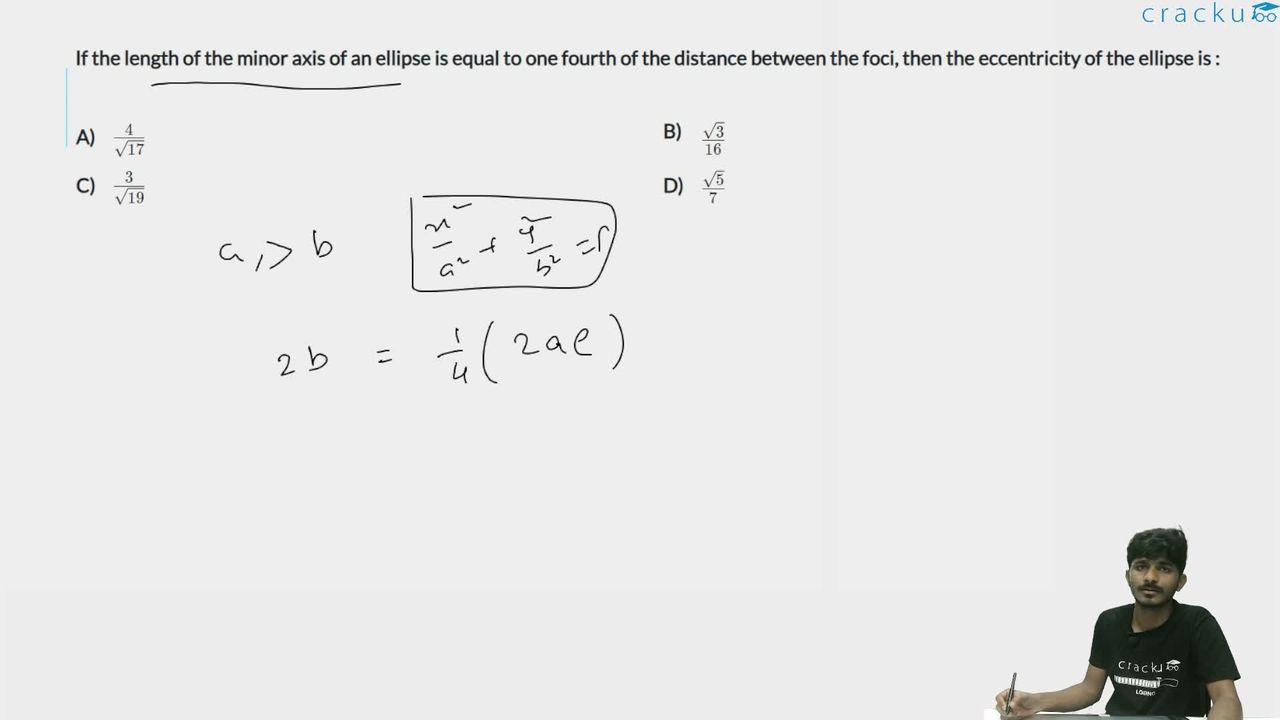
If the length of the minor axis of an ellipse is equal to one fourth of the distance between the foci, then the eccentricity of the ellipse is :
For an ellipse centred at the origin with the major axis along the $$x$$-axis, we use the standard form
$$\frac{x^{2}}{a^{2}}+\frac{y^{2}}{b^{2}}=1,\qquad a \gt b\,(\,\text{major}\, \gt \text{minor}\,)$$
Eccentricity: $$e=\sqrt{1-\frac{b^{2}}{a^{2}}}$$
Distance between the two foci: $$2ae$$
Length of the minor axis: $$2b$$
The question states: “length of the minor axis is one fourth of the distance between the foci”.
Translate this directly into an equation:
$$2b=\frac{1}{4}\times(2ae)$$
Simplify:
$$2b=\frac{ae}{2}\qquad\Longrightarrow\qquad4b=ae$$ $$-(1)$$
Replace $$b$$ by its expression in terms of $$a$$ and $$e$$. From the definition of eccentricity,
$$b=a\sqrt{1-e^{2}}$$ $$-(2)$$
Substitute $$(2)$$ into $$(1)$$:
$$4\bigl(a\sqrt{1-e^{2}}\bigr)=ae$$
Assuming $$a\neq0$$, divide both sides by $$a$$:
$$4\sqrt{1-e^{2}}=e$$
Square both sides to eliminate the square root:
$$16(1-e^{2})=e^{2}$$
Expand and collect like terms:
$$16-16e^{2}=e^{2}\qquad\Longrightarrow\qquad17e^{2}=16$$
Solve for $$e$$:
$$e^{2}=\frac{16}{17}\qquad\Longrightarrow\qquad e=\frac{4}{\sqrt{17}}$$
Since $$e$$ must be positive and less than 1, this value is acceptable.
Hence, the eccentricity of the ellipse is $$\frac{4}{\sqrt{17}}$$.
Option A is correct.
Was this solution helpful?
Click on the Email ☝️ to Watch the Video Solution
Create a FREE account and get:
_1.webp)

Educational materials for JEE preparation

Ask our AI anything

AI can make mistakes. Please verify important information.
AI can make mistakes. Please verify important information.


