
Join Our JEE Preparation Group
Prep with like-minded aspirants; Get access to free daily tests and study material.
Sign in
Please select an account to continue using cracku.in
↓ →
Join Our JEE Preparation Group
Prep with like-minded aspirants; Get access to free daily tests and study material.
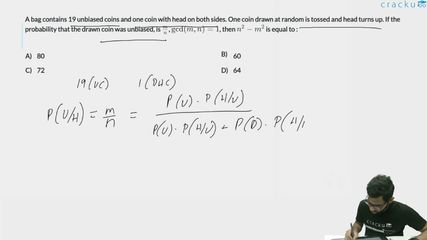
A bag contains 19 unbiased coins and one coin with head on both sides. One coin drawn at random is tossed and head turns up. If the probability that the drawn coin was unbiased, is $$\frac{m}{n}$$, $$\gcd(m, n) = 1$$, then $$n^2 - m^2$$ is equal to :
Let
$$U$$ : the drawn coin is unbiased (ordinary coin)
$$D$$ : the drawn coin is double-headed
$$H$$ : head turns up on the toss
Bayes’ theorem states
$$P(U\,|\,H)=\dfrac{P(U)\,P(H\,|\,U)}{P(U)\,P(H\,|\,U)+P(D)\,P(H\,|\,D)}$$ $$-(1)$$
Step 1: Prior probabilities of choosing a coin
There are 20 coins in all (19 unbiased + 1 double-headed).
$$P(U)=\frac{19}{20},\qquad P(D)=\frac{1}{20}$$
Step 2: Probabilities of getting head from each type
For an unbiased coin, head appears with probability $$\frac12$$: $$P(H\,|\,U)=\frac12$$.
For a double-headed coin, head always appears: $$P(H\,|\,D)=1$$.
Step 3: Use Bayes’ theorem
Substituting the values into $$(1)$$:
$$P(U\,|\,H)=\dfrac{\frac{19}{20}\times\frac12}{\frac{19}{20}\times\frac12+\frac{1}{20}\times1}$$
Simplify numerator and denominator separately:
Numerator $$=\frac{19}{20}\times\frac12=\frac{19}{40}$$
Denominator $$=\frac{19}{40}+\frac{1}{20}=\frac{19}{40}+\frac{2}{40}=\frac{21}{40}$$
Hence
$$P(U\,|\,H)=\frac{\frac{19}{40}}{\frac{21}{40}}=\frac{19}{21}$$
Step 4: Identify $$m$$ and $$n$$
The required probability is $$\frac{m}{n}=\frac{19}{21}$$ with $$\gcd(19,21)=1$$, so $$m=19$$ and $$n=21$$.
Step 5: Compute $$n^2-m^2$$
$$n^2-m^2=21^2-19^2=(21-19)(21+19)=2\times40=80$$
Therefore, $$n^2 - m^2 = 80$$.
Option A is correct.
Click on the Email ☝️ to Watch the Video Solution
Create a FREE account and get:
_1.webp)

Educational materials for JEE preparation

Ask our AI anything

AI can make mistakes. Please verify important information.
AI can make mistakes. Please verify important information.


