Join Our JEE Preparation Group
Prep with like-minded aspirants; Get access to free daily tests and study material.
Sign in
Please select an account to continue using cracku.in
↓ →
Join Our JEE Preparation Group
Prep with like-minded aspirants; Get access to free daily tests and study material.
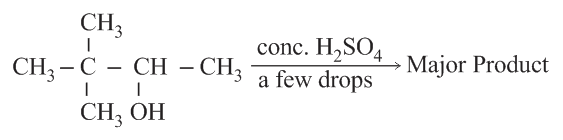
The acid-catalyzed dehydration of 3,3-dimethylbutan-2-ol proceeds through a detailed four-step mechanism:
Step 1: Protonation of the alcohol
The reaction begins with the strong acid, concentrated $$H_2SO_4$$, dissociating to provide a proton ($$H^+$$). The oxygen atom of the hydroxyl group ($$-OH$$) in 3,3-dimethylbutan-2-ol possesses lone electron pairs. One of these pairs acts as a base and accepts the proton. This step is crucial because the neutral hydroxyl group is a poor leaving group, but protonating it converts it into an oxonium ion ($$-OH_2^+$$), which is an excellent leaving group because it can depart as a stable, neutral water molecule.
Step 2: Formation of the secondary carbocation
Once the leaving group is formed, the carbon-oxygen bond breaks. The water molecule departs, taking both electrons from the bond with it. This leaves the carbon atom deficient in electrons, resulting in a full positive charge. Because the positively charged carbon is directly bonded to two other carbon atoms (one methyl group and one tert-butyl group), this intermediate is classified as a secondary carbocation.
Step 3: Carbocation rearrangement via a 1,2-methyl shift
Secondary carbocations are moderately stable, but the molecule will spontaneously rearrange if a more stable intermediate can be formed. Directly adjacent to the positively charged secondary carbon is a quaternary carbon atom (bonded entirely to other carbons, specifically three methyl groups). To achieve a lower overall energy state, an entire methyl group ($-CH_3$) migrates from the quaternary carbon to the adjacent positively charged carbon, taking its bonding pair of electrons with it. This specific rearrangement is called a 1,2-methyl shift. As a result, the positive charge moves to the carbon that just lost the methyl group. This new positively charged carbon is now bonded to three other carbons, making it a highly stable tertiary carbocation.
Step 4: Elimination to form the alkene
The final step is the elimination of a proton to form the carbon-carbon double bond, restoring neutrality to the molecule. A weak base present in the reaction mixture, such as water or the bisulfate ion ($$HSO_4^-$$), will remove a proton ($$H^+$$) from a carbon atom immediately adjacent to the positive charge.
The molecule has two main pathways for elimination:
Removing a proton from one of the outer methyl groups would yield a disubstituted alkene with very few alpha hydrogens.
Removing a proton from the adjacent carbon in the main chain yields a double bond right in the middle of the molecule.
Following Zaitsev's rule, elimination strongly favors the formation of the most highly substituted alkene because it is thermodynamically more stable. The proton is eliminated from the internal carbon, forming a double bond between the two central carbons. This results in a tetrasubstituted alkene, 2,3-dimethylbut-2-ene. This specific product is overwhelmingly favored because it is surrounded by four methyl groups, providing a massive total of 12 alpha hydrogens that stabilize the double bond through strong hyperconjugation.
Create a FREE account and get:
_1.webp)

Educational materials for JEE preparation

Ask our AI anything

AI can make mistakes. Please verify important information.
AI can make mistakes. Please verify important information.