Join Our JEE Preparation Group
Prep with like-minded aspirants; Get access to free daily tests and study material.
Sign in
Please select an account to continue using cracku.in
↓ →
Join Our JEE Preparation Group
Prep with like-minded aspirants; Get access to free daily tests and study material.
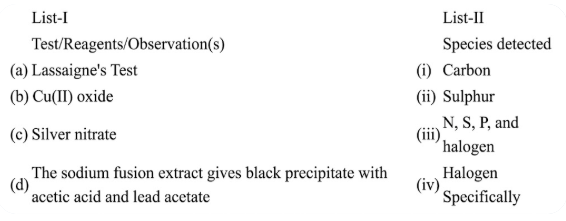
We match each test/reagent with the species it detects.
(a) Lassaigne's Test: In this test, the organic compound is fused with sodium metal to convert the elements present (nitrogen, sulphur, phosphorus, and halogens) into ionic compounds that can be detected in aqueous solution. Therefore, (a) matches with (iii) — N, S, P, and halogen.
(b) Cu(II) oxide: When an organic compound is heated with copper(II) oxide, the carbon in the compound is oxidised to $$CO_2$$, which can be detected by passing it through lime water (turning it milky). This test is used to detect the presence of carbon. Therefore, (b) matches with (i) — Carbon.
(c) Silver nitrate: The sodium fusion extract, when treated with silver nitrate solution, gives precipitates of silver halides ($$AgCl$$, $$AgBr$$, or $$AgI$$), which are used to specifically identify halogens. Therefore, (c) matches with (iv) — Halogen specifically.
(d) Black precipitate with acetic acid and lead acetate: When the sodium fusion extract containing sulphide ions is treated with acetic acid and lead acetate, a black precipitate of lead sulphide ($$PbS$$) is formed: $$Na_2S + Pb(CH_3COO)_2 \rightarrow PbS \downarrow + 2CH_3COONa$$. Therefore, (d) matches with (ii) — Sulphur.
The correct match is (a)-(iii), (b)-(i), (c)-(iv), (d)-(ii).
Was this solution helpful?
Create a FREE account and get:
_1.webp)

Educational materials for JEE preparation

Ask our AI anything

AI can make mistakes. Please verify important information.
AI can make mistakes. Please verify important information.