
Join Our JEE Preparation Group
Prep with like-minded aspirants; Get access to free daily tests and study material.
Sign in
Please select an account to continue using cracku.in
↓ →
Join Our JEE Preparation Group
Prep with like-minded aspirants; Get access to free daily tests and study material.
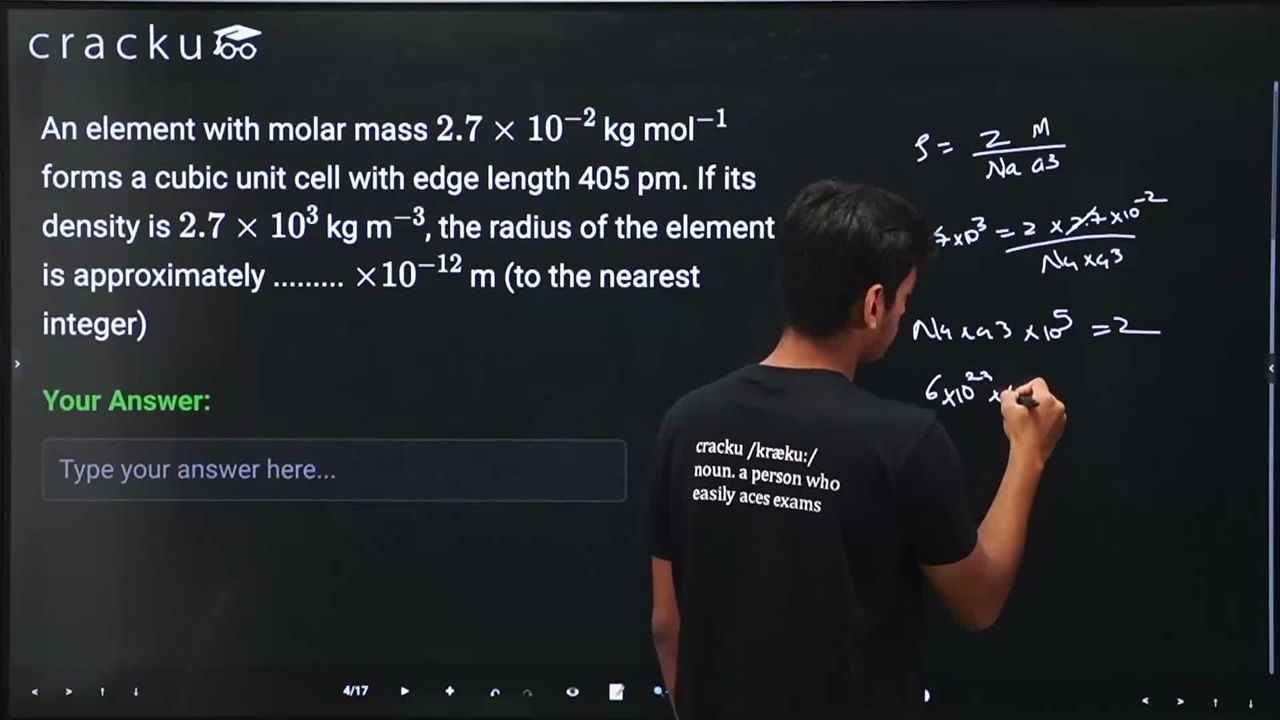
An element with molar mass $$2.7 \times 10^{-2}$$ kg mol$$^{-1}$$ forms a cubic unit cell with edge length 405 pm. If its density is $$2.7 \times 10^3$$ kg m$$^{-3}$$, the radius of the element is approximately ......... $$\times 10^{-12}$$ m (to the nearest integer)
Correct Answer: 143
We are given the data - molar mass $$M = 2.7 \times 10^{-2}\; \text{kg mol}^{-1}$$, edge length of the cubic unit cell $$a = 405\ \text{pm} = 405 \times 10^{-12}\ \text{m}$$ and density $$\rho = 2.7 \times 10^{3}\; \text{kg m}^{-3}$$. To identify the type of cubic unit cell we first connect these quantities through the density relation for crystals.
The general density formula is
$$\rho \;=\; \dfrac{Z\,M}{N_A\,a^{3}}$$
where $$Z$$ is the number of atoms per unit cell and $$N_A = 6.022 \times 10^{23}\ \text{mol}^{-1}$$ is Avogadro’s constant.
Re-arranging for $$Z$$ we get
$$Z \;=\; \dfrac{\rho\,N_A\,a^{3}}{M}$$
Now we substitute the given values one by one. First we evaluate $$a^{3}$$:
$$a = 405 \times 10^{-12}\ \text{m}$$
$$a^{3} = (405 \times 10^{-12})^{3} \text{ m}^{3} = 405^{3}\times 10^{-36}\ \text{m}^{3}$$
We calculate $$405^{3}$$ explicitly:
$$405^{3} = 405 \times 405 \times 405 = 164{,}025 \times 405 = 66{,}836{,}125$$
Hence
$$a^{3} = 66{,}836{,}125 \times 10^{-36}\ \text{m}^{3} = 6.6836125 \times 10^{-29}\ \text{m}^{3}$$
Next we assemble $$\rho N_A a^{3}$$:
$$\rho\,N_A\,a^{3} = (2.7 \times 10^{3})\,(6.022 \times 10^{23})\,(6.6836125 \times 10^{-29})$$
Multiplying the numerical parts in steps,
$$2.7 \times 6.022 = 16.2594$$
$$16.2594 \times 6.6836125 \approx 108.6707$$
For the powers of ten we have $$10^{3}\times10^{23}\times10^{-29}=10^{-3}$$. So
$$\rho\,N_A\,a^{3} \approx 108.6707 \times 10^{-3} = 0.1086707$$
Now we divide by the molar mass:
$$Z = \dfrac{0.1086707}{M}\,, \qquad M = 2.7 \times 10^{-2} = 0.027$$
$$Z = \dfrac{0.1086707}{0.027} \approx 4.024 \approx 4$$
Obtaining the nearest integer value $$Z = 4$$ tells us that the unit cell is face-centred cubic (fcc).
For an fcc lattice the relation between the edge length $$a$$ and the atomic radius $$r$$ is obtained from the face diagonal. On the face diagonal we have four radii, hence
$$4r = \sqrt{2}\,a \quad\Longrightarrow\quad r = \dfrac{\sqrt{2}}{4}\,a = \dfrac{a}{2\sqrt{2}}$$
Substituting $$a = 405 \times 10^{-12}\ \text{m}$$ gives
$$r = \dfrac{405 \times 10^{-12}}{2\sqrt{2}} = \dfrac{405}{2 \times 1.414}\times 10^{-12}\ \text{m}$$
Calculating the numerator-denominator ratio,
$$\dfrac{405}{2.828} \approx 143.2$$
Hence
$$r \approx 143.2 \times 10^{-12}\ \text{m}$$
and to the nearest integer the radius is $$143 \times 10^{-12}\ \text{m}$$.
Hence, the correct answer is Option 143.
Was this solution helpful?
Click on the Email ☝️ to Watch the Video Solution
Create a FREE account and get:
_1.webp)

Educational materials for JEE preparation

Ask our AI anything

AI can make mistakes. Please verify important information.
AI can make mistakes. Please verify important information.
