
Join Our JEE Preparation Group
Prep with like-minded aspirants; Get access to free daily tests and study material.
Sign in
Please select an account to continue using cracku.in
↓ →
Join Our JEE Preparation Group
Prep with like-minded aspirants; Get access to free daily tests and study material.
In the following sequence of reactions the maximum number of atoms present in molecule 'C' in one plane is __________.
A $$\xrightarrow[Cu tube]{\text{Red hot }}$$ B $$\xrightarrow[\text{Anhydrous AlCl}_3]{CH_3Cl(1 eq)}$$ C
(A is a lowest molecular weight alkyne)
Correct Answer: 13
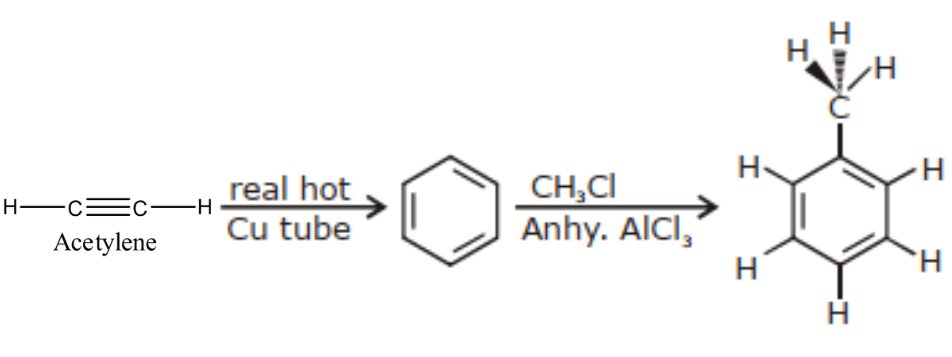
Let us begin with compound A. The statement “A is a lowest molecular weight alkyne” means the alkyne with the smallest possible number of carbon atoms, i.e. ethyne (acetylene), whose formula is $$HC\equiv CH$$.
Now this ethyne is passed over a red-hot copper tube. The textbook reaction that occurs under these conditions is the trimerisation of ethyne to benzene: three molecules of ethyne cyclise and lose hydrogen as shown below
$$3\,HC\equiv CH \;\xrightarrow[\;873\;{\rm K}\;]{\text{Red-hot Cu}}\; C_6H_6 + 3\,H_2$$
Thus, compound B is benzene, $$C_6H_6$$.
Next, benzene is treated with one equivalent of methyl chloride in the presence of anhydrous $$AlCl_3$$. This is a classical Friedel-Crafts alkylation. First we state the general formula:
Friedel-Crafts alkylation: $$\quad C_6H_6 + RCl \;\xrightarrow{AlCl_3}\; C_6H_5R + HCl$$
Substituting $$R = CH_3$$ and taking only one equivalent (so that only a single substitution occurs), we obtain
$$C_6H_6 + CH_3Cl \;\xrightarrow{AlCl_3}\; C_6H_5CH_3 + HCl$$
Therefore compound C is methylbenzene, commonly called toluene, whose condensed formula is $$C_6H_5CH_3$$.
We are now asked: “what is the maximum number of atoms present in molecule C in one plane?” To answer this we must look at the geometry of every atom in toluene.
• The six ring carbons in benzene are $$sp^2$$ hybridised; all $$sp^2$$ atoms and the σ-bonds between them lie in a single plane.
• The five hydrogens that remain on the ring (one hydrogen is replaced by the methyl group) are each bonded through an $$sp^2$$ carbon; the C-H σ-bond in an $$sp^2$$ centre is also contained in the same trigonal plane. Hence each of these five hydrogens can lie in that plane.
• The ring carbon that bears the side chain is itself $$sp^2$$ and already counted among the six ring carbons.
• The first carbon of the side chain (the methyl carbon, $$CH_3$$) is $$sp^3$$. In a tetrahedral $$sp^3$$ centre the central carbon and any one of its three substituents can be chosen to lie in the same plane as the benzene ring; the other two substituents must protrude above and below the plane. Hence the methyl carbon itself and exactly one of its three hydrogens can be co-planar with the ring.
Counting these atoms explicitly:
$$\begin{aligned} \text{Ring carbons} &= 6\\ \text{Hydrogens on the ring} &= 5\\ \text{Methyl (side-chain) carbon} &= 1\\ \text{One hydrogen of the CH}_3 &= 1\\ \hline \text{Total atoms that can be in one plane} &= 6 + 5 + 1 + 1 = 13 \end{aligned}$$
No other atom of toluene can be added to this plane without forcing a tetrahedral angle to straighten, so 13 is the absolute maximum.
So, the answer is $$13$$.
Was this solution helpful?
Click on the Email ☝️ to Watch the Video Solution
Create a FREE account and get:
_1.webp)

Educational materials for JEE preparation

Ask our AI anything

AI can make mistakes. Please verify important information.
AI can make mistakes. Please verify important information.


