
Join Our JEE Preparation Group
Prep with like-minded aspirants; Get access to free daily tests and study material.
Sign in
Please select an account to continue using cracku.in
↓ →
Join Our JEE Preparation Group
Prep with like-minded aspirants; Get access to free daily tests and study material.
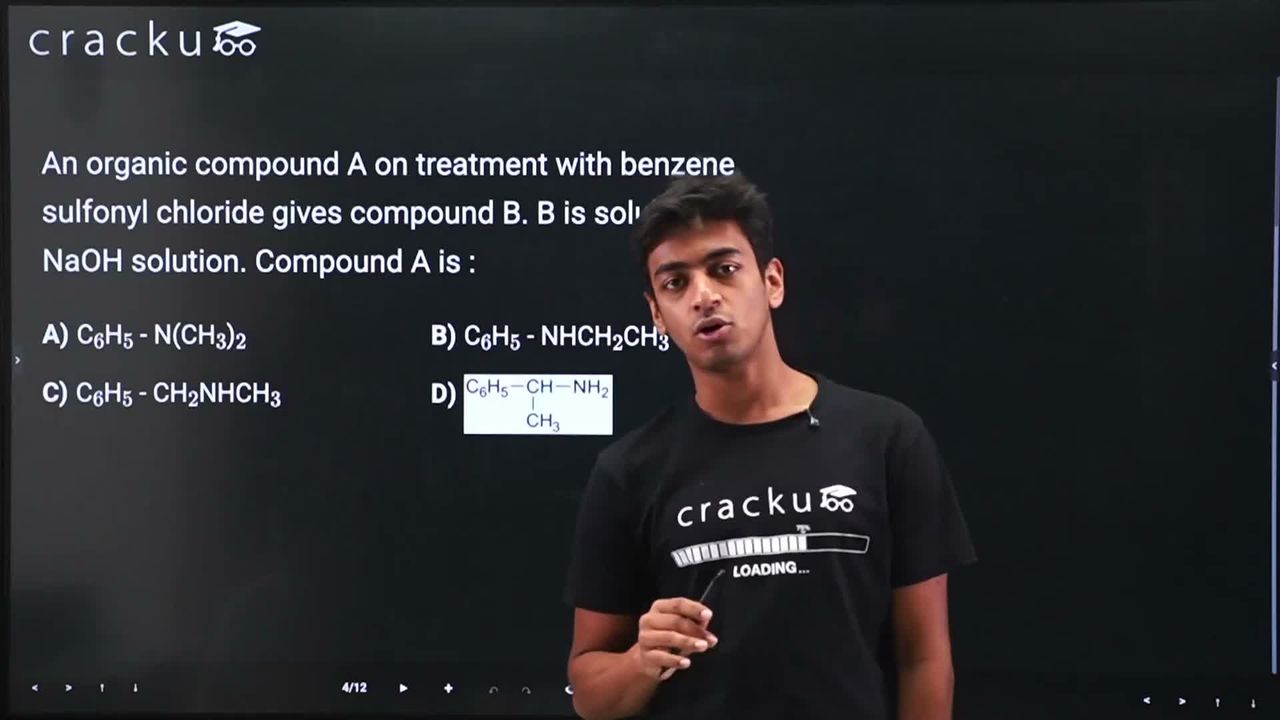
An organic compound A on treatment with benzene sulfonyl chloride gives compound B. B is soluble in dil. NaOH solution. Compound A is :
This problem uses the Hinsberg test, where an amine reacts with benzene sulfonyl chloride ($$\text{C}_6\text{H}_5\text{SO}_2\text{Cl}$$). The key observation is that the product B is soluble in dilute NaOH, which tells us that B contains an acidic $$\text{N-H}$$ proton, meaning the original amine A must be a primary amine ($$\text{R-NH}_2$$).
A primary amine reacts with benzenesulfonyl chloride to give $$\text{R-NHSO}_2\text{C}_6\text{H}_5$$, a sulfonamide that still has one N-H bond. This proton is acidic enough (due to the electron-withdrawing sulfonyl group) to be removed by dilute NaOH, making the product soluble in base. A secondary amine would give a sulfonamide with no N-H bond, so it would be insoluble in NaOH. A tertiary amine does not react with benzenesulfonyl chloride at all.
Among the options, $$\text{C}_6\text{H}_5\text{N}(\text{CH}_3)_2$$ (option 1) is a tertiary amine. $$\text{C}_6\text{H}_5\text{NHCH}_2\text{CH}_3$$ (option 2) is a secondary amine. $$\text{C}_6\text{H}_5\text{CH}_2\text{NHCH}_3$$ (option 3) is also a secondary amine. Only $$\text{C}_6\text{H}_5\text{CH}(\text{NH}_2)(\text{CH}_3)$$ (option 4) is a primary amine with a free $$-\text{NH}_2$$ group.
Therefore compound A is $$\text{C}_6\text{H}_5\text{CH}(-\text{NH}_2)(-\text{CH}_3)$$, option (4).
Was this solution helpful?
Click on the Email ☝️ to Watch the Video Solution
Create a FREE account and get:
_1.webp)

Educational materials for JEE preparation

Ask our AI anything

AI can make mistakes. Please verify important information.
AI can make mistakes. Please verify important information.
