
Join Our JEE Preparation Group
Prep with like-minded aspirants; Get access to free daily tests and study material.
Sign in
Please select an account to continue using cracku.in
↓ →
Join Our JEE Preparation Group
Prep with like-minded aspirants; Get access to free daily tests and study material.
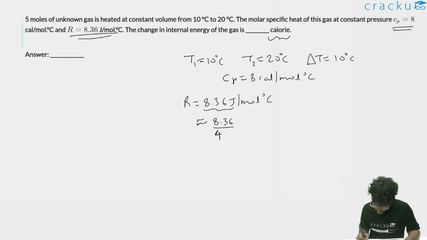
5 moles of unknown gas is heated at constant volume from 10 °C to 20 °C. The molar specific heat of this gas at constant pressure $$c_p = 8$$ cal/mol.°C and $$R = 8.36$$ J/mol.°C. The change in internal energy of the gas is _________ calorie.
Correct Answer: 300
The process is carried out at constant volume, so the change in internal energy $$\Delta U$$ is given by
$$\Delta U = n\,c_v\,\Delta T$$
where
$$n = 5$$ moles (amount of gas)
$$\Delta T = 20^{\circ}\text{C} - 10^{\circ}\text{C} = 10^{\circ}\text{C}$$ (temperature rise)
$$c_v$$ = molar specific heat at constant volume (to be found).
The data provided is the molar specific heat at constant pressure: $$c_p = 8$$ cal mol⁻¹ °C⁻¹.
For any ideal gas, the relation between molar heats is
$$c_p - c_v = R$$
We must use $$R$$ in the same units as $$c_p$$, i.e. calories. Given
$$R = 8.36\;\text{J mol}^{-1}\,^{\circ}\text{C}^{-1}$$
and $$1\;\text{cal} = 4.184\;\text{J}$$, we convert:
$$R = \frac{8.36}{4.184}\;\text{cal mol}^{-1}\,^{\circ}\text{C}^{-1} \approx 2.00\;\text{cal mol}^{-1}\,^{\circ}\text{C}^{-1}$$
Hence
$$c_v = c_p - R = 8 - 2 = 6\;\text{cal mol}^{-1}\,^{\circ}\text{C}^{-1}$$
Now calculate $$\Delta U$$:
$$\Delta U = n\,c_v\,\Delta T = 5 \times 6 \times 10 = 300\;\text{cal}$$
Therefore, the change in internal energy of the gas is 300 calorie.
Click on the Email ☝️ to Watch the Video Solution
Create a FREE account and get:
_1.webp)

Educational materials for JEE preparation

Ask our AI anything

AI can make mistakes. Please verify important information.
AI can make mistakes. Please verify important information.


