
Join Our JEE Preparation Group
Prep with like-minded aspirants; Get access to free daily tests and study material.
Sign in
Please select an account to continue using cracku.in
↓ →
Join Our JEE Preparation Group
Prep with like-minded aspirants; Get access to free daily tests and study material.
The major products obtained from the reactions in List-II are the reactants for the named reactions mentioned in List-I. Match each entry in List-I with the appropriate entry in List-II and choose the correct option.
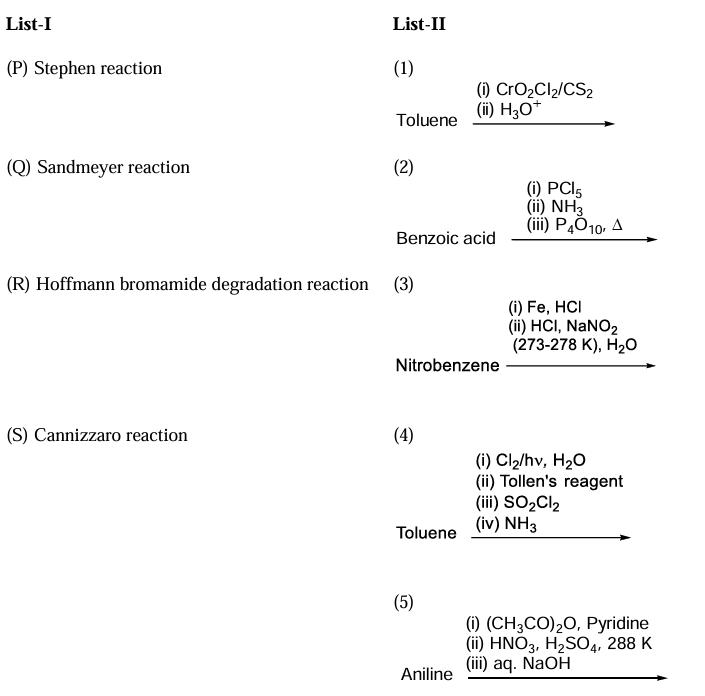
We begin by writing the four named reactions listed in List-I along with the specific substance that must be taken as the starting material (reactant) in each case.
• P : Kolbe-Schmitt (Kolbe) reaction - it is carried out with $$C_6H_5ONa$$ (sodium phenoxide).
• Q : Reimer-Tiemann reaction - it starts from free phenol $$C_6H_5OH$$ in strongly alkaline medium.
• R : Williamson ether synthesis - it is performed with an alkoxide ion such as $$RO^-\,Na^+$$ (sodium alkoxide).
• S : Etard reaction - the oxidation is applied to toluene $$C_6H_5CH_3$$ with $$CrO_2Cl_2$$ to give benzaldehyde.
Next, let us look at the transformations given in List-II and note the major product formed in each of them.
Case 1 (List-II entry 1) : Decarboxylation of benzoic acid with soda-lime $$C_6H_5COONa \xrightarrow[\text{soda-lime}]{\Delta } C_6H_5CH_3$$ Major product = $$C_6H_5CH_3$$ (toluene).
Case 2 (List-II entry 2) : Dow process / high-temperature hydrolysis of chlorobenzene $$C_6H_5Cl + 2\,NaOH \xrightarrow[623\,\text{K}]{320\,\text{atm}} C_6H_5ONa + NaCl + H_2O$$ Major product before acidification = $$C_6H_5ONa$$ (sodium phenoxide).
Case 3 (List-II entry 3) : Cumene (isopropylbenzene) oxidation followed by acid hydrolysis $$\text{Cumene} \xrightarrow[\text{air}]{\text{O}_2} \text{cumene hydro-peroxide} \xrightarrow[\text{dil.}~H_2SO_4]{} C_6H_5OH + (CH_3)_2CO$$ Major product = $$C_6H_5OH$$ (phenol).
Case 4 (List-II entry 4) : Reaction of ethanol with sodium metal $$2\,C_2H_5OH + 2\,Na \rightarrow 2\,C_2H_5ONa + H_2 \uparrow$$ Major product = $$C_2H_5ONa$$ (sodium ethoxide, a typical alkoxide).
Now we simply link each named reaction from List-I with the entry in List-II that furnishes the required reactant:
• P (Kolbe, needs $$C_6H_5ONa$$) ← produced in Case 2 ⇒ P→2.
• Q (Reimer-Tiemann, needs $$C_6H_5OH$$) ← produced in Case 3 ⇒ Q→3.
• R (Williamson ether synthesis, needs an alkoxide such as $$C_2H_5ONa$$) ← produced in Case 4 ⇒ R→4.
• S (Etard reaction, needs toluene $$C_6H_5CH_3$$) ← produced in Case 1 ⇒ S→1.
The correct matching is therefore P→2; Q→3; R→4; S→1.
Comparing this sequence with the options supplied, we find that it corresponds to
Option B which is: P→2; Q→3; R→4; S→1.
Was this solution helpful?
Create a FREE account and get:
_1.webp)

Educational materials for JEE preparation

Ask our AI anything

AI can make mistakes. Please verify important information.
AI can make mistakes. Please verify important information.
