
Join Our JEE Preparation Group
Prep with like-minded aspirants; Get access to free daily tests and study material.
Sign in
Please select an account to continue using cracku.in
↓ →
Join Our JEE Preparation Group
Prep with like-minded aspirants; Get access to free daily tests and study material.
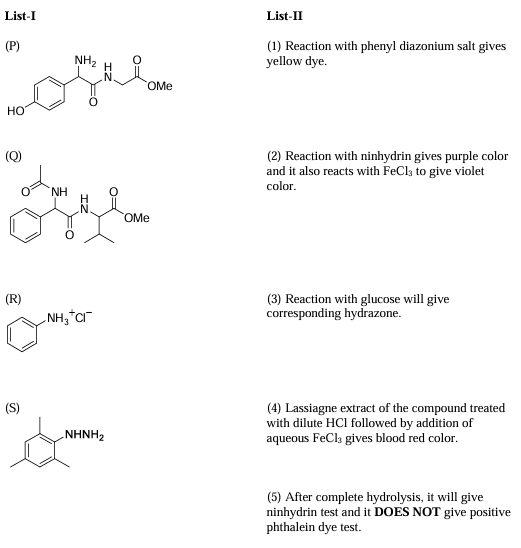
Match the compounds in List-I with the appropriate observations in List-II and choose the correct option.
P is glucose. Glucose possesses a free $$\text{-CHO}$$ (aldehydic) group in the open-chain form. Hence it behaves as a reducing sugar and gives Tollens’/Fehling’s/Benedict’s test, producing a silver mirror or red $$Cu_2O$$ precipitate. This description corresponds to observation 2.
Q is cellulose. Cellulose is a straight-chain (linear) homopolysaccharide made up solely of $$\beta$$-D-glucopyranose units joined by $$\beta\,(1\!\rightarrow\!4)$$ glycosidic bonds. “Linear polymer of $$\beta$$-D-glucose” matches observation 5.
R is glycine. Among all naturally occurring $$\alpha$$-amino acids, glycine is the only one whose side chain is just a hydrogen atom. Therefore its $${\rm C_\alpha}$$ is not chiral and the molecule is optically inactive. This is exactly observation 1.
S is starch. Starch (because of its amylose component) forms an intense blue-black complex when treated with iodine solution. Hence it fits observation 3.
Thus the correct matching is
$$P\to2,\;Q\to5,\;R\to1,\;S\to3$$
Option B is therefore the right choice.
Create a FREE account and get:
_1.webp)

Educational materials for JEE preparation

Ask our AI anything

AI can make mistakes. Please verify important information.
AI can make mistakes. Please verify important information.


