
Join Our JEE Preparation Group
Prep with like-minded aspirants; Get access to free daily tests and study material.
Sign in
Please select an account to continue using cracku.in
↓ →
Join Our JEE Preparation Group
Prep with like-minded aspirants; Get access to free daily tests and study material.
The correct match of the group reagents in List-I for precipitating the metal ion given in List-II from solutions, is
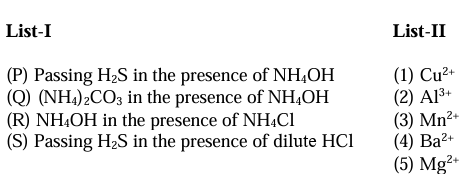
In qualitative inorganic analysis, cations are separated into groups by adding specific group reagents. Each reagent precipitates only those ions whose analytical product (sulfide, hydroxide, carbonate, etc.) has a very low solubility under the given conditions. We first recall the standard group scheme:
• Group II reagent : pass $$H_2S$$ in dilute $$HCl$$ (acidic medium) ⇒ precipitates insoluble sulfides such as $$CuS, CdS, PbS$$ …
• Group III reagent : add $$NH_4OH$$ in the presence of excess $$NH_4Cl$$ (buffered weakly basic) ⇒ precipitates gelatinous hydroxides $$Fe(OH)_3, Al(OH)_3, Cr(OH)_3$$ …
• Group IV reagent : pass $$H_2S$$ in basic medium (presence of $$NH_4OH$$) ⇒ precipitates the less‐insoluble sulfides $$ZnS, NiS, CoS, MnS$$ …
• Group V reagent : add $$(NH_4)_2CO_3$$ in presence of $$NH_4OH$$ ⇒ precipitates carbonates of alkaline-earth metals $$CaCO_3, SrCO_3, BaCO_3$$ …
Now match each List-I reagent with the metal ion of List-II whose salt is precipitated by that reagent.
Case P:Reagent : pass $$H_2S$$ in presence of $$NH_4OH$$ (alkaline) ⇒ Group IV.
Among the given ions, $$Mn^{2+}$$ forms the insoluble sulfide $$MnS$$ under these conditions.
Hence P → 3 ($$Mn^{2+}$$).
Reagent : $$(NH_4)_2CO_3$$ in presence of $$NH_4OH$$ ⇒ Group V.
Of the listed ions, $$Ba^{2+}$$ is an alkaline-earth metal and is precipitated as $$BaCO_3$$.
Hence Q → 4 ($$Ba^{2+}$$).
Reagent : $$NH_4OH$$ with $$NH_4Cl$$ buffer ⇒ Group III.
This reagent precipitates trivalent hydroxides; $$Al^{3+}$$ gives $$Al(OH)_3$$.
Hence R → 2 ($$Al^{3+}$$).
Reagent : pass $$H_2S$$ in dilute $$HCl$$ (acidic) ⇒ Group II.
$$Cu^{2+}$$ is a typical group-II cation, precipitated as black $$CuS$$.
Hence S → 1 ($$Cu^{2+}$$).
Collecting the matches: P → 3, Q → 4, R → 2, S → 1.
Therefore the correct option is:
Option A which is: P → 3; Q → 4; R → 2; S → 1.
Was this solution helpful?
Create a FREE account and get:
_1.webp)

Educational materials for JEE preparation

Ask our AI anything

AI can make mistakes. Please verify important information.
AI can make mistakes. Please verify important information.
