
Join Our JEE Preparation Group
Prep with like-minded aspirants; Get access to free daily tests and study material.
Sign in
Please select an account to continue using cracku.in
↓ →
Join Our JEE Preparation Group
Prep with like-minded aspirants; Get access to free daily tests and study material.
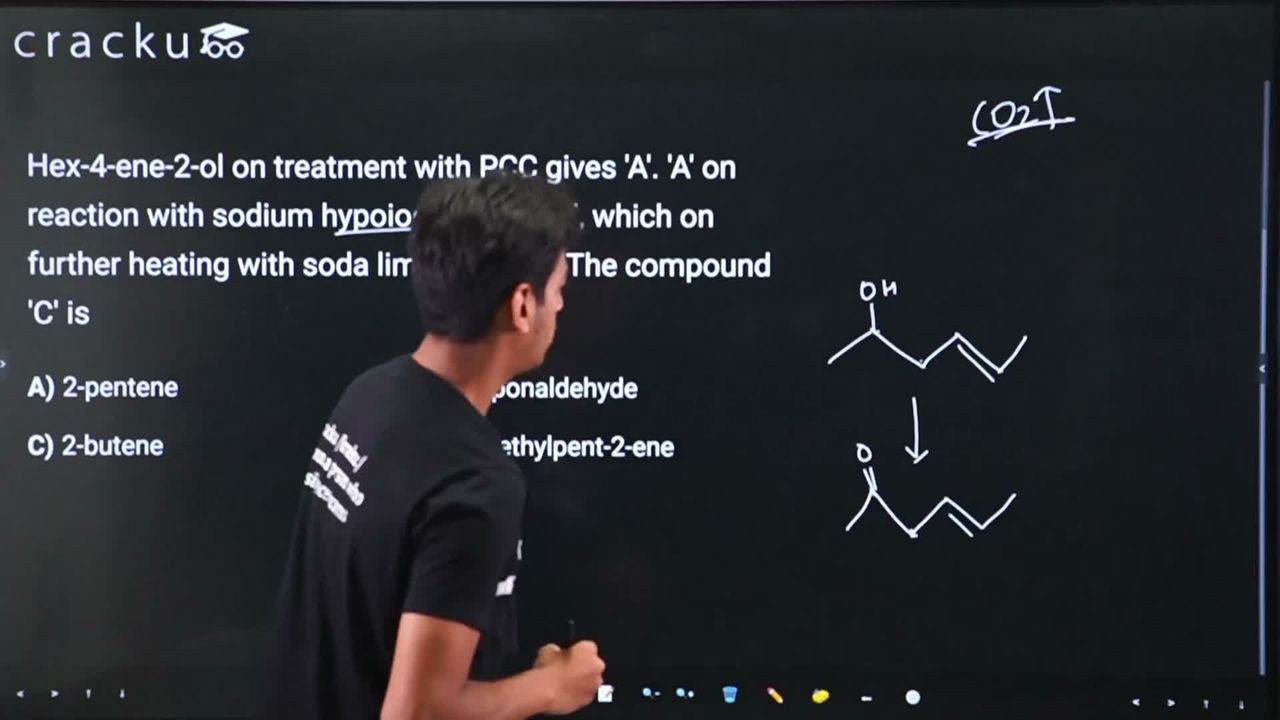
Hex-4-ene-2-ol on treatment with PCC gives 'A'. 'A' on reaction with sodium hypoiodite gives 'B', which on further heating with soda lime gives 'C'. The compound 'C' is
We need to follow the sequence of reactions starting from hex-4-en-2-ol, which has the structure: $$CH_3-CH(OH)-CH_2-CH=CH-CH_3$$.
PCC (Pyridinium Chlorochromate) is a mild oxidizing agent that converts a secondary alcohol to a ketone without further oxidation. $$CH_3-CH(OH)-CH_2-CH=CH-CH_3 \xrightarrow{PCC} CH_3-CO-CH_2-CH=CH-CH_3$$ Compound A is hex-4-en-2-one.
Sodium hypoiodite is the iodoform reagent. It reacts with methyl ketones ($$R-CO-CH_3$$) to give a carboxylate salt and iodoform ($$CHI_3$$): $$CH_3-CO-CH_2-CH=CH-CH_3 + 3NaOI \to CHI_3 + CH_3-CH=CH-CH_2-COONa$$. Compound B is sodium pent-3-enoate ($$CH_3CH=CHCH_2COONa$$).
Heating sodium pent-3-enoate with soda lime ($$NaOH + CaO$$) causes decarboxylation, removing $$CO_2$$ and replacing the $$-COONa$$ group with $$-H$$: $$CH_3-CH=CH-CH_2-COONa \xrightarrow{NaOH/CaO} CH_3-CH=CH-CH_3 + Na_2CO_3$$. Compound C is 2-butene ($$CH_3CH=CHCH_3$$).
The correct answer is Option C: 2-butene.
Was this solution helpful?
Click on the Email ☝️ to Watch the Video Solution
Create a FREE account and get:
_1.webp)

Educational materials for JEE preparation

Ask our AI anything

AI can make mistakes. Please verify important information.
AI can make mistakes. Please verify important information.
