
Join Our JEE Preparation Group
Prep with like-minded aspirants; Get access to free daily tests and study material.
Sign in
Please select an account to continue using cracku.in
↓ →
Join Our JEE Preparation Group
Prep with like-minded aspirants; Get access to free daily tests and study material.
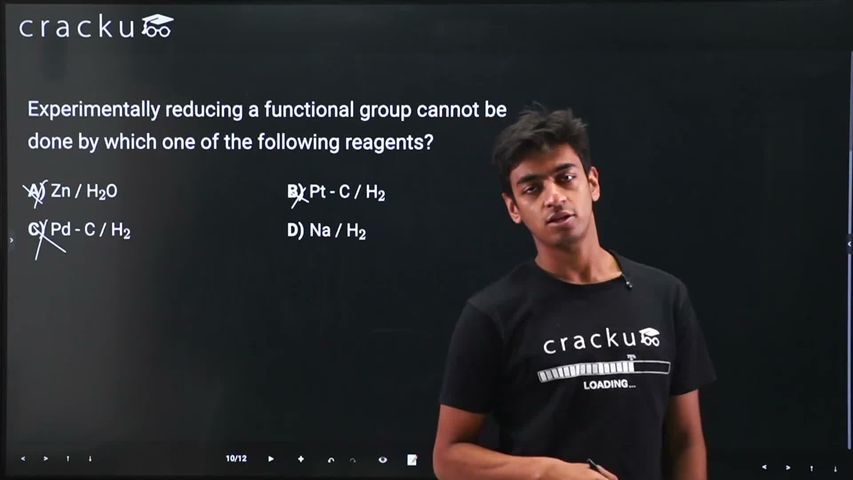
Experimentally reducing a functional group cannot be done by which one of the following reagents?
To decide which reagent is incapable of reducing an organic functional group in the laboratory, we recall the basic principle of reduction in organic chemistry: reduction involves the addition of hydrogen (or the removal of oxygen) and is usually accomplished by either (i) nascent hydrogen produced in situ or (ii) catalytic hydrogenation in which molecular hydrogen is added across a multiple bond in the presence of a metal catalyst.
We now examine each option in the light of this principle.
Option A: $$\text{Zn / H}_2\text{O}$$ — Metallic zinc reacts with water (especially in the presence of acid) to generate nascent hydrogen according to the well-known reaction
$$
\text{Zn} + 2\,\text{H}_2\text{O} \;\longrightarrow\; \text{Zn(OH)}_2 + 2\,[\text{H}]
$$
The freshly produced $$[\text{H}]$$ (nascent hydrogen) is able to reduce several functional groups (for example, the Clemmensen reduction formally uses Zn/Hg in acid to reduce carbonyl groups). Hence Zn/H$$_2$$O can act as a reducing system.
Option B: $$\text{Pt-C / H}_2$$ — In catalytic hydrogenation, finely divided platinum supported on carbon adsorbs molecular hydrogen according to
$$
\text{H}_2 \overset{\text{Pt-C}}{\rightarrow} 2\,[\text{H}]
$$
These adsorbed hydrogen atoms readily add to C=C, C≡C and several other reducible functional groups. Therefore Pt-C/H$$_2$$ is a powerful laboratory reducing agent.
Option C: $$\text{Pd-C / H}_2$$ — Palladium on carbon functions in exactly the same catalytic manner as platinum. It is one of the most frequently used reagents for hydrogenation of alkenes, alkynes, nitro groups, etc. Hence Pd-C/H$$_2$$ also reduces functional groups effectively.
Option D: $$\text{Na / H}_2$$ — Here we merely have metallic sodium physically mixed with molecular hydrogen. Sodium metal does not adsorb hydrogen in a way that produces active $$[\text{H}]$$ atoms, nor does it catalyse the dissociation of H$$_2$$. Consequently, no nascent or catalytic hydrogen is available and the mixture fails to reduce ordinary organic functional groups under experimental conditions.
Thus, among the four reagents listed, the only one that cannot serve as a practical reducing system is $$\text{Na / H}_2$$.
Hence, the correct answer is Option 4.
Was this solution helpful?
Click on the Email ☝️ to Watch the Video Solution
Create a FREE account and get:
_1.webp)

Educational materials for JEE preparation

Ask our AI anything

AI can make mistakes. Please verify important information.
AI can make mistakes. Please verify important information.
