
Join Our JEE Preparation Group
Prep with like-minded aspirants; Get access to free daily tests and study material.
Sign in
Please select an account to continue using cracku.in
↓ →
Join Our JEE Preparation Group
Prep with like-minded aspirants; Get access to free daily tests and study material.
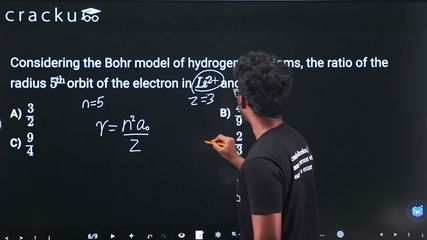
Considering the Bohr model of hydrogen like atoms, the ratio of the radius $$5^{\text{th}}$$ orbit of the electron in $$Li^{2+}$$ and $$He^+$$ is
For a hydrogen-like ion, Bohr’s radius of the electron in the $$n^{\text{th}}$$ orbit is given by
$$r_n = \frac{n^{2}a_0}{Z}$$
where $$a_0$$ is the Bohr radius of the first orbit of the hydrogen atom and $$Z$$ is the atomic number of the nucleus.
Both $$Li^{2+}$$ and $$He^{+}$$ have a single electron, so the same formula applies.
Case 1: $$Li^{2+}$$
For lithium, $$Z_{Li}=3$$ and for the $$5^{\text{th}}$$ orbit, $$n=5$$.
$$r_{Li} = \frac{(5)^2\,a_0}{3}= \frac{25a_0}{3}$$
Case 2: $$He^{+}$$
For helium, $$Z_{He}=2$$ and again $$n=5$$.
$$r_{He} = \frac{(5)^2\,a_0}{2}= \frac{25a_0}{2}$$
Now compute the required ratio:
$$\frac{r_{Li}}{r_{He}} = \frac{\dfrac{25a_0}{3}}{\dfrac{25a_0}{2}} = \frac{2}{3}$$
Hence, the ratio of the radii is $$\dfrac{2}{3}$$.
Option D is correct.
Was this solution helpful?
Click on the Email ☝️ to Watch the Video Solution
Create a FREE account and get:
_1.webp)

Educational materials for JEE preparation

Ask our AI anything

AI can make mistakes. Please verify important information.
AI can make mistakes. Please verify important information.
