
Join Our JEE Preparation Group
Prep with like-minded aspirants; Get access to free daily tests and study material.
Sign in
Please select an account to continue using cracku.in
↓ →
Join Our JEE Preparation Group
Prep with like-minded aspirants; Get access to free daily tests and study material.
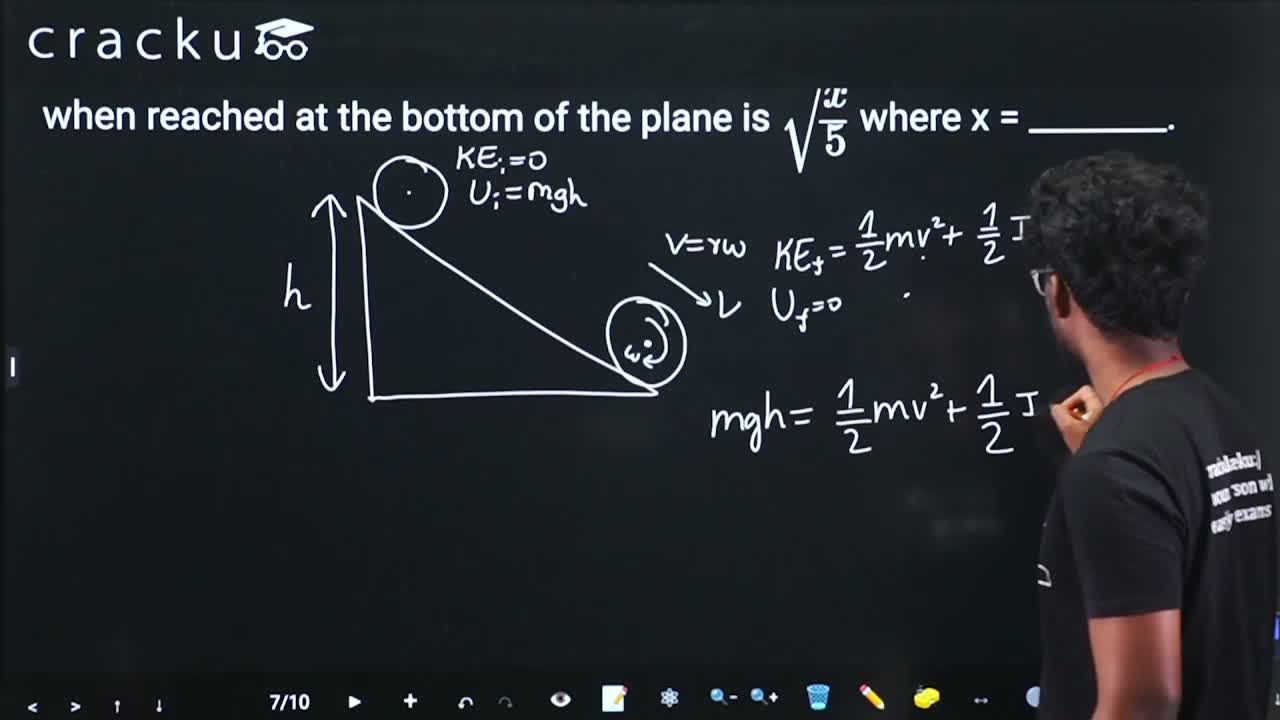
A circular ring and a solid sphere having same radius roll down on an inclined plane from rest without slipping. The ratio of their velocities when reached at the bottom of the plane is $$\sqrt{\dfrac{x}{5}}$$ where x = ________.
Correct Answer: 3.5
For any rigid body rolling without slipping down an inclined plane, conservation of mechanical energy gives
$$mgh \;=\;\frac12\,m v^{2}\;+\;\frac12\,I\omega^{2}$$
Since the body rolls without slipping, $$\omega=\dfrac{v}{R}$$. Thus
$$mgh \;=\;\frac12\,m v^{2}\;+\;\frac12\,I\dfrac{v^{2}}{R^{2}} =\frac12\,m v^{2}\Bigl(1+\frac{I}{mR^{2}}\Bigr)$$
Therefore the speed attained at the bottom is
$$v=\sqrt{\frac{2gh}{\,1+\dfrac{I}{mR^{2}}\,}}$$
Case 1 : Circular ring
For a thin ring about its symmetry axis, $$I_{ring}=mR^{2}$$, so $$\dfrac{I}{mR^{2}}=1$$.
$$v_{ring}=\sqrt{\frac{2gh}{1+1}} =\sqrt{\frac{2gh}{2}} =\sqrt{gh}$$
Case 2 : Solid sphere
For a solid sphere about a diameter, $$I_{sphere}=\tfrac{2}{5}mR^{2}$$, hence $$\dfrac{I}{mR^{2}}=\tfrac{2}{5}$$.
$$v_{sphere}=\sqrt{\frac{2gh}{1+\tfrac{2}{5}}} =\sqrt{\frac{2gh}{\tfrac{7}{5}}} =\sqrt{\frac{10gh}{7}}$$
Required ratio:
$$\frac{v_{ring}}{v_{sphere}} =\sqrt{\frac{gh}{\tfrac{10gh}{7}}} =\sqrt{\frac{7}{10}} =\sqrt{\frac{3.5}{5}}$$
Hence $$x=3.5$$.
Thus, the ratio of their velocities at the bottom of the plane is $$\sqrt{\dfrac{3.5}{5}}$$, giving $$x = 3.5$$.
Was this solution helpful?
Click on the Email ☝️ to Watch the Video Solution
Create a FREE account and get:
_1.webp)

Educational materials for JEE preparation

Ask our AI anything

AI can make mistakes. Please verify important information.
AI can make mistakes. Please verify important information.
