
Join Our JEE Preparation Group
Prep with like-minded aspirants; Get access to free daily tests and study material.
Sign in
Please select an account to continue using cracku.in
↓ →
Join Our JEE Preparation Group
Prep with like-minded aspirants; Get access to free daily tests and study material.
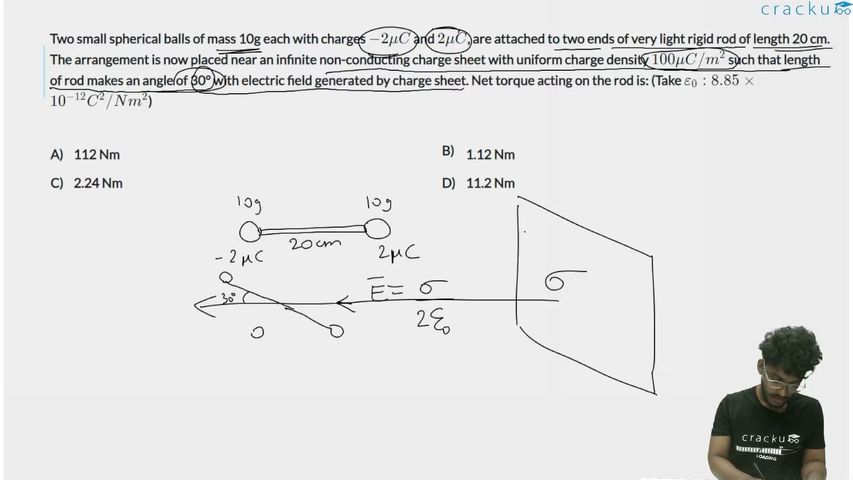
Two small spherical balls of mass 10g each with charges $$-2\mu C$$ and $$2\mu C$$, are attached to two ends of very light rigid rod of length 20 cm. The arrangement is now placed near an infinite non-conducting charge sheet with uniform charge density $$100 \mu C/m^2$$ such that length of rod makes an angle of 30° with electric field generated by charge sheet. Net torque acting on the rod is: (Take $$\varepsilon_0 : 8.85 \times 10^{-12} C^2/Nm^2$$)
Electric field due to infinite non-conducting sheet is
$$E=\frac{\sigma}{2\varepsilon_0}$$
Given
$$\sigma=100\mu C/m^2=10^{-4}C/m^2$$
So
$$E=\frac{10^{-4}}{2(8.85\times10^{-12})}$$
$$=5.65\times10^6\text{ N/C}$$
Force on each charge:
F=qEF
with
$$q=2\times10^{-6}C$$
So
$$F=(2\times10^{-6})(5.65\times10^6)$$
=11.3N
The two equal and opposite charges form an electric dipole.
Dipole moment
p=qd
where
d=20cm=0.2m
So
$$p=(2\times10^{-6})(0.2)=4\times10^{-7}$$
Torque on dipole in electric field:
$$\tau=pE\sin\theta$$
with
$$\theta=30^{\circ}$$
Thus
$$\tau=(4\times10^{-7})(5.65\times10^6)\cdot\frac{1}{2}$$
$$=1.13Nm$$
Was this solution helpful?
Click on the Email ☝️ to Watch the Video Solution
Create a FREE account and get:
_1.webp)

Educational materials for JEE preparation

Ask our AI anything

AI can make mistakes. Please verify important information.
AI can make mistakes. Please verify important information.
